
352103-000-00-KM-01, Theory of Sound-Knwledge Module
Theory of Sound (352103-000-00-KM-01)
NQF Level: 5
Credits: 18
Duration: 180 Hours
🧭 COURSE OVERVIEW
Description:
This course introduces learners to the physics of sound, including wave behavior, sound properties, human perception, and applications in music and audio engineering.
Learning Outcomes:
- Understand sound as a mechanical wave
- Analyse sound properties (frequency, amplitude, intensity)
- Explain sound behaviour (reflection, Doppler, interference)
- Apply concepts to musical instruments and audio systems
Introduction to the Theory of Sound
1. The theory of sound describes how vibrations propagate as waves through a medium, like air, causing pressure changes that we perceive as sound. It encompasses the physics of sound production, transmission, and perception, including concepts like frequency, amplitude, and wave behavior.
Here’s a more detailed breakdown:
1. Sound as Vibration and Waves:
- Sound is fundamentally a vibration that creates pressure waves.
- These waves travel through a medium, like air, water, or solids, by causing particles to oscillate back and forth.
- This creates areas of compression (higher pressure) and rarefaction (lower pressure) that move through the medium.
- Think of a stone dropped in a pond, creating outward ripples; sound waves do the same, but in three dimensions.
Reference Video: Audio Basics (Part 1)
This video explains how sound waves are created and travel through the air:
2. Key Properties of Sound Waves:
Measured in Hertz (Hz), frequency describes how many times per second the sound pressure oscillates. It determines pitch (how high or low a sound is perceived).
Related to the intensity or loudness of the sound, amplitude describes the magnitude of the pressure variation. It’s often measured in decibels (dB).
- Wavelength:
The distance between two consecutive peaks or troughs in a wave.
- Speed of Sound:
The speed at which sound waves travel through a medium, affected by the medium’s properties.
3. How We Hear Sound:
- Sound waves enter the ear and cause the eardrum to vibrate.
- These vibrations are then transmitted and amplified through the middle ear.
- Finally, the vibrations reach the inner ear, where they are converted into electrical signals that the brain interprets as sound.
4. Sound in Different Media:
- Sound can travel through various media, including solids, liquids, and gases.
- The speed and characteristics of sound waves vary depending on the medium’s properties (density, elasticity, etc.).
- For example, sound travels faster in water than in air, and faster in solids than in liquids.
5. Applications of Sound Theory:
- Understanding sound theory is crucial in fields like acoustics, music, audio engineering, and even medical imaging (ultrasound).
- It helps in designing soundproof spaces, creating musical instruments, and developing technologies that utilize sound waves.
6. Key Figures in Sound Theory:
- Lord Rayleigh:
A key figure in the development of the theory of sound, particularly through his two-volume work, ”The Theory of Sound“.
- Hermann von Helmholtz:
Made significant contributions to the understanding of human hearing and the perception of sound.
The Nature of a Sound Wave (Sound Waves and Music)
- Reflection of Sound Waves. …
- Sonar stands for sound navigation and ranging. …
- Ultrasound and Infrasound. …
- Echolocation- the use of sound waves to determine distance or to locate objects. …
- Ultrasound in the Ocean.
- Wave theory
When a vibrating object, like a piano string or speaker cone, disrupts the air molecules around it, a chain reaction is set off. This creates areas of higher and lower density, known as compressions and rarefactions, which transfer energy away from the vibrating object.
- Sound waves and reflections
When sound waves bounce off walls or ceilings, they can arrive at your ear at different times. If the direct sound and the reflected sound are in different air pressure states, they can cancel each other out. This is the principle behind noise-cancelling headphones.
- The Doppler effect
When the source of waves is moving relative to an observer, the Doppler effect occurs. For example, when an ambulance with its siren blaring passes by, the Doppler effect is demonstrated.
- The speed of sound
The speed of sound can be affected by the movement of the medium it’s traveling through. For example, if sound and wind are moving in the same direction, the sound’s speed increases. If they’re moving in opposite directions, the sound’s speed decreases.
- Echolocation
Bats use echolocation to navigate and hunt by producing ultrasonic sound waves that bounce off objects in their surroundings. By detecting the time delay between the sound waves they send out and the ones that reflect back, bats can estimate the distance to nearby objects. The theory of sound is based on classical physics and can be applied in many ways, including:
- Understanding how humans perceive sound
The place theory of hearing explains how humans perceive high-pitched sounds. When sound waves reach the basilar membranes in the auditory nerve, the brain interprets the neural signals to determine the pitch of the sound.
- Understanding the relationship between sound and force
Newton’s second law of motion relates force to acceleration, which can be applied to the theory of sound. Newton developed a theory that relates the velocity of sound to the density and compressibility of a medium.
- Understanding how sound changes over time
The scientific view of sound treats it as an event-like particular whose location in a medium changes over time.
- Understanding the effects of temperature on sound
The velocity of sound transmission is affected by changes in temperature that occur when gases compress or dilate.
- Understanding masking
Masking is when one person’s speech is masked by another person talking at the same time.
- Understanding ultrasound
Ultrasound is sound waves with frequencies higher than 20,000 Hz, which humans cannot hear. Medical ultrasound is used for diagnostics and treatment.
The Physics Classroom Topics
The motion of objects in one-dimension are described using words, diagrams, numbers, graphs, and equations.
Newton’s three laws of motion are explained and their application to the analysis of the motion of objects in one dimension is discussed.
Vectors – Motion and Forces in Two Dimensions
Vector principles and operations are introduced and combined with kinematic principles and Newton’s laws to describe, explain and analyze the motion of objects in two dimensions. Applications include riverboat problems, projectiles, inclined planes, and static equilibrium.
The impulse-momentum change theorem and the law of conservation of momentum are introduced, explained and applied to the analysis of explosions and the collisions of objects.
Concepts of work, kinetic energy and potential energy are discussed; these concepts are combined with the work-energy theorem to provide a convenient means of analyzing an object or system of objects moving between an initial and final state.
Circular Motion and Satellite Motion
Newton’s laws of motion and kinematic principles are applied to describe and explain the motion of objects moving in circles; specific applications are made to roller coasters and athletics. Newton’s Universal Law of Gravitation is then presented and utilized to explain the circular and elliptical motion of planets and satellites.
The distinction between heat and temperature is thoroughly explained. Methods of heat transfer are explained. The mathematics associated with temperature changes and phase changes is discussed; its application to the science of calorimetry is presented.
Basic principles of electrostatics are introduced in order to explain how objects become charged and to describe the effect of those charges on other objects in the neighboring surroundings. Charging methods, electric field lines and the importance of lightning rods on homes are among the topics discussed in this unit.
The flow of charge through electric circuits is discussed in detail. The variables which cause and hinder the rate of charge flow are explained and the mathematical application of electrical principles to series, parallel and combination circuits is presented.
The nature, properties and behaviors of waves are discussed and illustrated; the unique nature of a standing wave is introduced and explained.
The nature of sound as a longitudinal, mechanical pressure wave is explained and the properties of sound are discussed. Wave principles of resonance and standing waves are applied in an effort to analyze the physics of musical instruments.
The behavior of light waves is introduced and discussed; polarization, color, diffraction and interference are introduced as supporting evidence of the wave nature of light. Color perception is discussed in detail.
Reflection and the Ray Model of Light
The ray nature of light is used to explain how light reflects off of planar and curved surfaces to produce both real and virtual images; the nature of the images produced by plane mirrors, concave mirrors, and convex mirrors is thoroughly illustrated.
Refraction and the Ray Model of Light
The ray nature of light is used to explain how light refracts at planar and curved surfaces; Snell’s law and refraction principles are used to explain a variety of real-world phenomena; refraction principles are combined with ray diagrams to explain why lenses produce images of objects.
[Text Box]
………………………………………………………………………………………………………………………………………………………………………………………………………………………………………………………………………………………………………………………………………………………………………………………………………………………………………………………………………………………………………………………………………………………………………………………………………………………………………………………………………………………………………………………………………………………………………………………………………………………………………………………………………………………………………………………………………………………………………………………………………………………………………………………………………………………………………………………………………………………
NB: VIDEOS FOR REFERENCE FOUND IN THE FOLDER “VIDEO”
FOUND ON YOUR DESKTOP
Lesson 1 – The Nature of a Sound Wave – Sound Waves and Music
a. Sound is a Mechanical Wave

Sound and music are parts of our everyday sensory experience. Just as humans have eyes for the detection of light and color, so we are equipped with ears for the detection of sound. We seldom take the time to ponder the characteristics and behaviors of sound and the mechanisms by which sounds are produced, propagated, and detected. The basis for an understanding of sound, music and hearing is the physics of waves. Sound is a wave that is created by vibrating objects and propagated through a medium from one location to another. In this unit, we will investigate the nature, properties and behaviors of sound waves and apply basic wave principles towards an understanding of music.
As discussed in the previous unit of The Physics Classroom Tutorial, a wave can be described as a disturbance that travels through a medium, transporting energy from one location to another location. The medium is simply the material through which the disturbance is moving; it can be thought of as a series of interacting particles. The example of a slinky wave is often used to illustrate the nature of a wave. A disturbance is typically created within the slinky by the back and forth movement of the first coil of the slinky. The first coil becomes disturbed and begins to push or pull on the second coil. This push or pull on the second coil will displace the second coil from its equilibrium position. As the second coil becomes displaced, it begins to push or pull on the third coil; the push or pull on the third coil displaces it from its equilibrium position. As the third coil becomes displaced, it begins to push or pull on the fourth coil. This process continues in consecutive fashion, with each individual particle acting to displace the adjacent particle. Subsequently the disturbance travels through the slinky. As the disturbance moves from coil to coil, the energy that was originally introduced into the first coil is transported along the medium from one location to another.

A sound wave is similar in nature to a slinky wave for a variety of reasons. First, there is a medium that carries the disturbance from one location to another. Typically, this medium is air, though it could be any material such as water or steel. The medium is simply a series of interconnected and interacting particles. Second, there is an original source of the wave, some vibrating object capable of disturbing the first particle of the medium. The disturbance could be created by the vibrating vocal cords of a person, the vibrating string and soundboard of a guitar or violin, the vibrating tines of a tuning fork, or the vibrating diaphragm of a radio speaker. Third, the sound wave is transported from one location to another by means of particle-to-particle interaction. If the sound wave is moving through air, then as one air particle is displaced from its equilibrium position, it exerts a push or pull on its nearest neighbors, causing them to be displaced from their equilibrium position. This particle interaction continues throughout the entire medium, with each particle interacting and causing a disturbance of its nearest neighbors. Since a sound wave is a disturbance that is transported through a medium via the mechanism of particle-to-particle interaction, a sound wave is characterized as a mechanical wave.
Production and Propagation of Sound Waves
The creation and propagation of sound waves are often demonstrated in class through the use of a tuning fork. A tuning fork is a metal object consisting of two tines capable of vibrating if struck by a rubber hammer or mallet. As the tines of the tuning forks vibrate back and forth, they begin to disturb surrounding air molecules. These disturbances are passed on to adjacent air molecules by the mechanism of particle interaction. The motion of the disturbance, originating at the tines of the tuning fork and traveling through the medium (in this case, air) is what is referred to as a sound wave. The generation and propagation of a sound wave is demonstrated in the animation below.

Many Physics demonstration tuning forks are mounted on a sound box. In such instances, the vibrating tuning fork, being connected to the sound box, sets the sound box into vibrational motion. In turn, the sound box, being connected to the air inside of it, sets the air inside of the sound box into vibrational motion. As the tines of the tuning fork, the structure of the sound box, and the air inside of the sound box begin vibrating at the same frequency, a louder sound is produced. In fact, the more particles that can be made to vibrate, the louder or more amplified the sound. This concept is often demonstrated by the placement of a vibrating tuning fork against the glass panel of an overhead projector or on the wooden door of a cabinet. The vibrating tuning fork sets the glass panel or wood door into vibrational motion and results in an amplified sound.
We know that a tuning fork is vibrating because we hear the sound that is produced by its vibration. Nonetheless, we do not actually visibly detect any vibrations of the tines. This is because the tines are vibrating at a very high frequency. If the tuning fork that is being used corresponds to middle C on the piano keyboard, then the tines are vibrating at a frequency of 256 Hertz; that is, 256 vibrations per second. We are unable to visibly detect vibrations of such high frequency. A common physics demonstration involves slowing down the vibrations by through the use of a strobe light. If the strobe light puts out a flash of light at a frequency of 512 Hz (two times the frequency of the tuning fork), then the tuning fork can be observed to be moving in a back and forth motion. With the room darkened, the strobe would allow us to view the position of the tines two times during their vibrational cycle. Thus we would see the tines when they are displaced far to the left and again when they are displaced far to the right. This would be convincing proof that the tines of the tuning fork are indeed vibrating to produce sound.
In a previous unit of The Physics Classroom Tutorial, a distinction was made between two categories of waves: mechanical waves and electromagnetic waves. Electromagnetic waves are waves that have an electric and magnetic nature and are capable of traveling through a vacuum. Electromagnetic waves do not require a medium in order to transport their energy. Mechanical waves are waves that require a medium in order to transport their energy from one location to another. Because mechanical waves rely on particle interaction in order to transport their energy, they cannot travel through regions of space that are void of particles. That is, mechanical waves cannot travel through a vacuum. This feature of mechanical waves is often demonstrated in a Physics class. A ringing bell is placed in a jar and air inside the jar is evacuated. Once air is removed from the jar, the sound of the ringing bell can no longer be heard. The clapper is seen striking the bell; but the sound that it produces cannot be heard because there are no particles inside of the jar to transport the disturbance through the vacuum. Sound is a mechanical wave and cannot travel through a vacuum.
Check Your Understanding
1. A sound wave is different than a light wave in that a sound wave is
a. produced by an oscillating object and a light wave is not.
b. not capable of traveling through a vacuum.
c. not capable of diffracting and a light wave is.
d. capable of existing with a variety of frequencies and a light wave has a single frequency An
Answer: B
Sound is a mechanical wave and cannot travel through a vacuum. Light is an electromagnetic wave and can travel through the vacuum of outer space.sw
b. Sound as a Longitudinal Wave
In the first part of Lesson 1, it was mentioned that sound is a mechanical wave that is created by a vibrating object. The vibrations of the object set particles in the surrounding medium in vibrational motion, thus transporting energy through the medium. For a sound wave traveling through air, the vibrations of the particles are best described as longitudinal. Longitudinal waves are waves in which the motion of the individual particles of the medium is in a direction that is parallel to the direction of energy transport. A longitudinal wave can be created in a slinky if the slinky is stretched out in a horizontal direction and the first coils of the slinky are vibrated horizontally. In such a case, each individual coil of the medium is set into vibrational motion in directions parallel to the direction that the energy is transported.
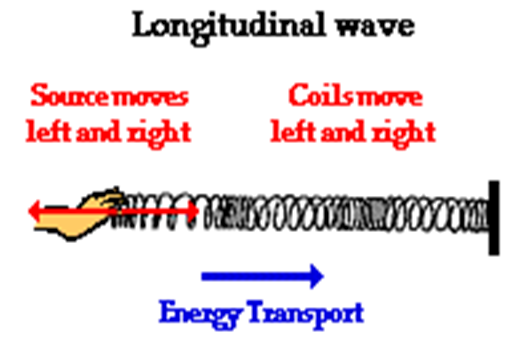

Sound waves in air (and any fluid medium) are longitudinal waves because particles of the medium through which the sound is transported vibrate parallel to the direction that the sound wave moves. A vibrating string can create longitudinal waves as depicted in the animation below. As the vibrating string moves in the forward direction, it begins to push upon surrounding air molecules, moving them to the right towards their nearest neighbor. This causes the air molecules to the right of the string to be compressed into a small region of space. As the vibrating string moves in the reverse direction (leftward), it lowers the pressure of the air immediately to its right, thus causing air molecules to move back leftward. The lower pressure to the right of the string causes air molecules in that region immediately to the right of the string to expand into a large region of space. The back and forth vibration of the string causes individual air molecules (or a layer of air molecules) in the region immediately to the right of the string to continually vibrate back and forth horizontally. The molecules move rightward as the string moves rightward and then leftward as the string moves leftward. These back and forth vibrations are imparted to adjacent neighbors by particle-to-particle interaction. Other surrounding particles begin to move rightward and leftward, thus sending a wave to the right. Since air molecules (the particles of the medium) are moving in a direction that is parallel to the direction that the wave moves, the sound wave is referred to as a longitudinal wave. The result of such longitudinal vibrations is the creation of compressions and rarefactions within the air.

Regardless of the source of the sound wave – whether it is a vibrating string or the vibrating tines of a tuning fork – sound waves traveling through air are longitudinal waves. And the essential characteristic of a longitudinal wave that distinguishes it from other types of waves is that the particles of the medium move in a direction parallel to the direction of energy transport.
We Would Like to Suggest …
Why just read about it and when you could be interacting with it? Interact – that’s exactly what you do when you use one of The Physics Classroom’s Interactives. We would like to suggest that you combine the reading of this page with the use of our Simple Wave Simulator. You can find it in the Physics Interactives section of our website. The Simple Wave Simulator provides the learner an environment to explore the distinction between longitudinal and transverse waves, the wavelength-frequency-period relationship, sound waves as pressure waves, and much more.
[Text Box] : Do a research on: Simple Wave Simulator
C.Sound is a Pressure Wave
What is a Pressure Wave?
Since a sound wave consists of a repeating pattern of high-pressure and low-pressure regions moving through a medium, it is sometimes referred to as a pressure wave. If a detector, whether it is the human ear or a man-made instrument, were used to detect a sound wave, it would detect fluctuations in pressure as the sound wave impinges upon the detecting device. At one instant in time, the detector would detect a high pressure; this would correspond to the arrival of a compression at the detector site. At the next instant in time, the detector might detect normal pressure. And then finally a low pressure would be detected, corresponding to the arrival of a rarefaction at the detector site. The fluctuations in pressure as detected by the detector occur at periodic and regular time intervals. In fact, a plot of pressure versus time would appear as a sine curve. The peak points of the sine curve correspond to compressions; the low points correspond to rarefactions; and the “zero points” correspond to the pressure that the air would have if there were no disturbance moving through it. The diagram below depicts the correspondence between the longitudinal nature of a sound wave in air and the pressure-time fluctuations that it creates at a fixed detector location.
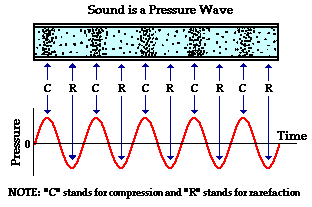
The above diagram can be somewhat misleading if you are not careful. The representation of sound by a sine wave is merely an attempt to illustrate the sinusoidal nature of the pressure-time fluctuations. Do not conclude that sound is a transverse wave that has crests and troughs. Sound waves traveling through air are indeed longitudinal waves with compressions and rarefactions. As sound passes through air (or any fluid medium), the particles of air do not vibrate in a transverse manner. Do not be misled – sound waves traveling through air are longitudinal waves.
We Would Like to Suggest …
Why just read about it and when you could be interacting with it? Interact – that’s exactly what you do when you use one of The Physics Classroom’s Interactives. We would like to suggest that you combine the reading of this page with the use of our Simple Wave Simulator. You can find it in the Physics Interactives section of our website. The Simple Wave Simulator provides the learner an environment to explore the distinction between longitudinal and transverse waves, the wavelength-frequency-period relationship, sound waves as pressure waves, and much more.
Visit: Simple Wave Simulator
Check Your Understanding
1. A sound wave is a pressure wave; regions of high (compressions) and low pressure (rarefactions) are established as the result of the vibrations of the sound source. These compressions and rarefactions result because sound
a. is more dense than air and thus has more inertia, causing the bunching up of sound.
b. waves have a speed that is dependent only upon the properties of the medium.
c. is like all waves; it is able to bend into the regions of space behind obstacles.
d. is able to reflect off fixed ends and interfere with incident waves
e. vibrates longitudinally; the longitudinal movement of air produces pressure fluctuations.
Answer: E
Since the particles of the medium vibrate in a longitudinal fashion, compressions and rarefactions are created. Study the tuning fork animation provided on the Tutorial page.
Note: sound is a pressure wave because it consists of a pattern of alternating high and low pressure regions, also known as compressions and rarefactions:
Here’s some more information about sound waves:
- How sound waves are created
Sound waves are created by vibrations from a sound source, such as a ringing cellphone. These vibrations cause the particles in the medium through which the sound wave is traveling to move back and forth.
- How sound waves travel
Sound waves travel through mediums like air, water, and solids. In gases, plasma, and liquids, sound waves are longitudinal waves, which means the particles move parallel to the direction of the wave’s energy. In solids, sound waves can be longitudinal or transverse.
- How sound waves spread
Sound waves spread out from their source in all directions, becoming less intense as they move farther away.
- How sound waves are detected
When sound waves reach the human ear, the ear detects the rarefactions as low-pressure periods and the compressions as high-pressure periods
[Text Box]
Notes:
………………………………………………………………………………………………………………………………………………………………………………………………………………………………………………………………………………………………………………………………………………………………………………………………………………………………………………………………………………………………………………………………………………………………………………………………………………………………………………………………………………………………………………………………………………………………………………………………………………………………………………………………………………………………………………………………………………………………………………………………………………………………………………………………………………………………………………………………………………………………………………………………………………………………………………………………………………………………………………………………………………………………………
Lesson 2 – Sound Properties and Their Perception (Sound Waves and Music)
a. Pitch and Frequency
A sound wave, like any other wave, is introduced into a medium by a vibrating object. The vibrating object is the source of the disturbance that moves through the medium. The vibrating object that creates the disturbance could be the vocal cords of a person, the vibrating string and sound board of a guitar or violin, the vibrating tines of a tuning fork, or the vibrating diaphragm of a radio speaker. Regardless of what vibrating object is creating the sound wave, the particles of the medium through which the sound moves is vibrating in a back and forth motion at a given frequency. The frequency of a wave refers to how often the particles of the medium vibrate when a wave passes through the medium. The frequency of a wave is measured as the number of complete back-and-forth vibrations of a particle of the medium per unit of time. If a particle of air undergoes 1000 longitudinal vibrations in 2 seconds, then the frequency of the wave would be 500 vibrations per second. A commonly used unit for frequency is the Hertz (abbreviated Hz), where
1 Hertz = 1 vibration/second

As a sound wave moves through a medium, each particle of the medium vibrates at the same frequency. This is sensible since each particle vibrates due to the motion of its nearest neighbor. The first particle of the medium begins vibrating, at say 500 Hz, and begins to set the second particle into vibrational motion at the same frequency of 500 Hz. The second particle begins vibrating at 500 Hz and thus sets the third particle of the medium into vibrational motion at 500 Hz. The process continues throughout the medium; each particle vibrates at the same frequency. And of course the frequency at which each particle vibrates is the same as the frequency of the original source of the sound wave. Subsequently, a guitar string vibrating at 500 Hz will set the air particles in the room vibrating at the same frequency of 500 Hz, which carries a sound signal to the ear of a listener, which is detected as a 500 Hz sound wave.
The back-and-forth vibrational motion of the particles of the medium would not be the only observable phenomenon occurring at a given frequency. Since a sound wave is a pressure wave, a detector could be used to detect oscillations in pressure from a high pressure to a low pressure and back to a high pressure. As the compressions (high pressure) and rarefactions (low pressure) move through the medium, they would reach the detector at a given frequency. For example, a compression would reach the detector 500 times per second if the frequency of the wave were 500 Hz. Similarly, a rarefaction would reach the detector 500 times per second if the frequency of the wave were 500 Hz. The frequency of a sound wave not only refers to the number of back-and-forth vibrations of the particles per unit of time, but also refers to the number of compressions or rarefactions that pass a given point per unit of time. A detector could be used to detect the frequency of these pressure oscillations over a given period of time. The typical output provided by such a detector is a pressure-time plot as shown below.

Since a pressure-time plot shows the fluctuations in pressure over time, the period of the sound wave can be found by measuring the time between successive high pressure points (corresponding to the compressions) or the time between successive low pressure points (corresponding to the rarefactions). As discussed in an earlier unit, the frequency is simply the reciprocal of the period. For this reason, a sound wave with a high frequency would correspond to a pressure time plot with a small period – that is, a plot corresponding to a small amount of time between successive high pressure points. Conversely, a sound wave with a low frequency would correspond to a pressure time plot with a large period – that is, a plot corresponding to a large amount of time between successive high pressure points. The diagram below shows two pressure-time plots, one corresponding to a high frequency and the other to a low frequency.
Frequency, Pitch and Human Perception
The ears of a human (and other animals) are sensitive detectors capable of detecting the fluctuations in air pressure that impinge upon the eardrum. The mechanics of the ear’s detection ability will be discussed later in this lesson. For now, it is sufficient to say that the human ear is capable of detecting sound waves with a wide range of frequencies, ranging between approximately 20 Hz to 20 000 Hz. Any sound with a frequency below the audible range of hearing (i.e., less than 20 Hz) is known as an infrasound and any sound with a frequency above the audible range of hearing (i.e., more than 20 000 Hz) is known as an ultrasound. Humans are not alone in their ability to detect a wide range of frequencies. Dogs can detect frequencies as low as approximately 50 Hz and as high as 45 000 Hz. Cats can detect frequencies as low as approximately 45 Hz and as high as 85 000 Hz. Bats, being nocturnal creature, must rely on sound echolocation for navigation and hunting. Bats can detect frequencies as high as 120 000 Hz. Dolphins can detect frequencies as high as 200 000 Hz. While dogs, cats, bats, and dolphins have an unusual ability to detect ultrasound, an elephant possesses the unusual ability to detect infrasound, having an audible range from approximately 5 Hz to approximately 10 000 Hz.
The sensation of a frequency is commonly referred to as the pitch of a sound. A high pitch sound corresponds to a high frequency sound wave and a low pitch sound corresponds to a low frequency sound wave. Amazingly, many people, especially those who have been musically trained, are capable of detecting a difference in frequency between two separate sounds that is as little as 2 Hz. When two sounds with a frequency difference of greater than 7 Hz are played simultaneously, most people are capable of detecting the presence of a complex wave pattern resulting from the interference and superposition of the two sound waves. Certain sound waves when played (and heard) simultaneously will produce a particularly pleasant sensation when heard, are said to be consonant. Such sound waves form the basis of intervals in music. For example, any two sounds whose frequencies make a 2:1 ratio are said to be separated by an octave and result in a particularly pleasing sensation when heard. That is, two sound waves sound good when played together if one sound has twice the frequency of the other. Similarly two sounds with a frequency ratio of 5:4 are said to be separated by an interval of a third; such sound waves also sound good when played together. Examples of other sound wave intervals and their respective frequency ratios are listed in the table below.
| Interval | Frequency Ratio | Examples |
| Octave | 2:1 | 512 Hz and 256 Hz |
| Third | 5:4 | 320 Hz and 256 Hz |
| Fourth | 4:3 | 342 Hz and 256 Hz |
| Fifth | 3:2 | 384 Hz and 256 Hz |
The ability of humans to perceive pitch is associated with the frequency of the sound wave that impinges upon the ear. Because sound waves traveling through air are longitudinal waves that produce high- and low-pressure disturbances of the particles of the air at a given frequency, the ear has an ability to detect such frequencies and associate them with the pitch of the sound. But pitch is not the only property of a sound wave detectable by the human ear. In the next part of Lesson 2, we will investigate the ability of the ear to perceive the intensity of a sound wave.
Investigate!
Every musical note is associated with a unique frequency. The two widgets below allow you to investigate the relationship between a musical note and the associated frequency.
| Find the Frequency | ||
| Top of Form Enter a musical note (A, B, C, D, F#, etc.) and click the Find Frequency button to determine its frequency. Musical Note: [Control] Find Frequency Bottom of Form | ||
Check Your Understanding
1. Two musical notes that have a frequency ratio of 2:1 are said to be separated by an octave. A musical note that is separated by an octave from middle C (256 Hz) has a frequency of _____.
| a. 128 Hz | b. 254 Hz | c. 258 Hz |
| d. 345 Hz | e. none of these |
See Answer
Answer: A
Two notes separated by an octave have a frequency ration of 2:1. If a note is one octave below 256 Hz, then it must have one-half the frequency.
b. Intensity and the Decibel Scale
Sound waves are introduced into a medium by the vibration of an object. For example, a vibrating guitar string forces surrounding air molecules to be compressed and expanded, creating a pressure disturbance consisting of an alternating pattern of compressions and rarefactions. The disturbance then travels from particle to particle through the medium, transporting energy as it moves. The energy that is carried by the disturbance was originally imparted to the medium by the vibrating string. The amount of energy that is transferred to the medium is dependent upon the amplitude of vibrations of the guitar string. If more energy is put into the plucking of the string (that is, more work is done to displace the string a greater amount from its rest position), then the string vibrates with a greater amplitude. The greater amplitude of vibration of the guitar string thus imparts more energy to the medium, causing air particles to be displaced a greater distance from their rest position. Subsequently, the amplitude of vibration of the particles of the medium is increased, corresponding to an increased amount of energy being carried by the particles. This relationship between energy and amplitude was discussed in more detail in a previous unit.
Sound Intensity and Distance
The amount of energy that is transported past a given area of the medium per unit of time is known as the intensity of the sound wave. The greater the amplitude of vibrations of the particles of the medium, the greater the rate at which energy is transported through it, and the more intense that the sound wave is. Intensity is the energy/time/area; and since the energy/time ratio is equivalent to the quantity power, intensity is simply the power/area.

Typical units for expressing the intensity of a sound wave are Watts/meter2.
As a sound wave carries its energy through a two-dimensional or three-dimensional medium, the intensity of the sound wave decreases with increasing distance from the source. The decrease in intensity with increasing distance is explained by the fact that the wave is spreading out over a circular (2 dimensions) or spherical (3 dimensions) surface and thus the energy of the sound wave is being distributed over a greater surface area. The diagram at the right shows that the sound wave in a 2-dimensional medium is spreading out in space over a circular pattern. Since energy is conserved and the area through which this energy is transported is increasing, the intensity (being a quantity that is measured on a per area basis) must decrease.
The mathematical relationship between intensity and distance is sometimes referred to as an inverse square relationship. The intensity varies inversely with the square of the distance from the source. So if the distance from the source is doubled (increased by a factor of 2), then the intensity is quartered (decreased by a factor of 4). Similarly, if the distance from the source is quadrupled, then the intensity is decreased by a factor of 16. Applied to the diagram at the right, the intensity at point B is one-fourth the intensity as point A and the intensity at point C is one-sixteenth the intensity at point A. Since the intensity-distance relationship is an inverse relationship, an increase in one quantity corresponds to a decrease in the other quantity. And since the intensity-distance relationship is an inverse square relationship, whatever factor by which the distance is increased, the intensity is decreased by a factor equal to the square of the distance change factor. The sample data in the table below illustrate the inverse square relationship between power and distance.
| Distance | Intensity |
| 1 m | 160 units |
| 2 m | 40 units |
| 3 m | 17.8 units |
| 4 m | 10 units |
The Threshold of Hearing and the Decibel Scale
Humans are equipped with very sensitive ears capable of detecting sound waves of extremely low intensity. The faintest sound that the typical human ear can detect has an intensity of 1*10-12 W/m2. This intensity corresponds to a pressure wave in which a compression of the particles of the medium increases the air pressure in that compressional region by a mere 0.3 billionth of an atmosphere. A sound with an intensity of 1*10-12 W/m2 corresponds to a sound that will displace particles of air by a mere one-billionth of a centimeter. The human ear can detect such a sound. WOW! This faintest sound that a human ear can detect is known as the threshold of hearing (TOH). The most intense sound that the ear can safely detect without suffering any physical damage is more than one billion times more intense than the threshold of hearing.
Since the range of intensities that the human ear can detect is so large, the scale that is frequently used by physicists to measure intensity is a scale based on powers of 10. This type of scale is sometimes referred to as a logarithmic scale. The scale for measuring intensity is the decibel scale. The threshold of hearing is assigned a sound level of 0 decibels (abbreviated 0 dB); this sound corresponds to an intensity of 1*10-12 W/m2. A sound that is 10 times more intense ( 1*10-11 W/m2) is assigned a sound level of 10 dB. A sound that is 10*10 or 100 times more intense (1*10-10 W/m2) is assigned a sound level of 20 db. A sound that is 10*10*10 or 1000 times more intense (1*10-9 W/m2) is assigned a sound level of 30 db. A sound that is 10*10*10*10 or 10000 times more intense (1*10-8 W/m2) is assigned a sound level of 40 db. Observe that this scale is based on powers of 10. If one sound is 10x times more intense than another sound, then it has a sound level that is 10*x more decibels than the less intense sound. The table below lists some common sounds with an estimate of their intensity and decibel level.
| Source | Intensity | Intensity Level | # of Times Greater Than TOH |
| Threshold of Hearing (TOH) | 1*10-12 W/m2 | 0 dB | 100 |
| Rustling Leaves | 1*10-11 W/m2 | 10 dB | 101 |
| Whisper | 1*10-10 W/m2 | 20 dB | 102 |
| Normal Conversation | 1*10-6 W/m2 | 60 dB | 106 |
| Busy Street Traffic | 1*10-5 W/m2 | 70 dB | 107 |
| Vacuum Cleaner | 1*10-4 W/m2 | 80 dB | 108 |
| Large Orchestra | 6.3*10-3 W/m2 | 98 dB | 109.8 |
| Walkman at Maximum Level | 1*10-2 W/m2 | 100 dB | 1010 |
| Front Rows of Rock Concert | 1*10-1 W/m2 | 110 dB | 1011 |
| Threshold of Pain | 1*101 W/m2 | 130 dB | 1013 |
| Military Jet Takeoff | 1*102 W/m2 | 140 dB | 1014 |
| Instant Perforation of Eardrum | 1*104 W/m2 | 160 dB | 1016 |
Investigate!
Knowing the intensity of a sound wave allows one to calculate the deciBel (dB) level of that sound. Use the DeciBel Calculator widget to determine the deciBel rating from any intensity in Watt/meter2. Enter intensities using scientific notation – for example, enter 5e-5 for 5.0×10⁻⁵.
| DeciBel Calculator | ||
| Top of Form Enter the intensity of a sound in W/m^2: [Control] Then click Submit to view the deciBel rating. Submit Bottom of Form | ||
Do you want to learn how to do the mathematics yourself? Maybe it’s a course objective and just having the answer given to you by an online widget isn’t going to get you through the test. Take some time to learn how to calculate the intensity from the deciBel rating and the deciBel rating from the intensity:

Loudness and Intensity
While the intensity of a sound is a very objective quantity that can be measured with sensitive instrumentation, the loudness of a sound is more of a subjective response that will vary with a number of factors. The same sound will not be perceived to have the same loudness to all individuals. Age is one factor that affects the human ear’s response to a sound. Quite obviously, your grandparents do not hear like they used to. The same intensity sound would not be perceived to have the same loudness to them as it would to you. Furthermore, two sounds with the same intensity but different frequencies will not be perceived to have the same loudness. Because of the human ear’s tendency to amplify sounds having frequencies in the range from 1000 Hz to 5000 Hz, sounds with these intensities seem louder to the human ear. Despite the distinction between intensity and loudness, it is safe to state that the more intense sounds will be perceived to be the loudest sounds.
Investigate!
As mentioned in the previous paragraph, even the frequency will affect our perception of the loudness of a sound. For instance, a 100 Hz sound at 60 dB will not sound as loud as a 1000 Hz sound at 60 deciBel. Fletcher–Munson curves or equal loudness curves are often used to demonstrate the perceived loudness of a sound for a given frequency. Use the widget to investigate the effect of the frequency upon the perceived loudness and to view the equal loudness curves.
| Determine the Perceived Loudness of a Sound | ||
| Top of Form Frequency (Hz): [Control] DeciBel Rating (dB): [Control] Submit Bottom of Form | ||
Check Your Understanding
1. A mosquito’s buzz is often rated with a decibel rating of 40 dB. Normal conversation is often rated at 60 dB. How many times more intense is normal conversation compared to a mosquito’s buzz?
| a. 2 | b. 20 | c. 100 | d. 200 | e. 400 |
See Answer
Answer: C. 100 times
Normal conversation is 20 dB more intense. This 20 db difference corresponds to a 2-Bel difference. This difference is equivalent to a sound which is 102 more intense. Always raise 10 to a power which is equivalent to the difference in “Bels.”
2. The table at the right represents the decibel level for several sound sources. Use the table to make comparisons of the intensities of the following sounds.
How many times more intense is the front row of a Smashin’ Pumpkins concert than …
a. … the 15th row of the same concert?
b. … the average factory?
c. … normal speech?
d. … the library after school?
e. … the sound that most humans can just barely hear?

a. 10 X more intense - consistent with a 10 dBel (or 1 Bel) difference between the two sound levels.
b. 102 X more intense - consistent with a 20 dBel (or 2 Bel) difference between the two sound levels.
c. 105 X more intense - consistent with a 50 dBel (or 5 Bel) difference between the two sound levels.
d. 107 X more intense - consistent with a 70 dBel (or 7 Bel) difference between the two sound levels.
e. 1011 X more intense - consistent with a 110 dBel (or 11 Bel) difference between the two sound levels
3. On a good night, the front row of the Twisted Sister concert would surely result in a 120 dB sound level. An IPod produces 100 dB. How many IPods would be needed to produce the same intensity as the front row of the Twisted Sister concert?
Answer: 100 IPods
Since 120 db is 102 times or 100 times more intense than 100 dB. It is necessary to wear 100 IPods to produce the same sound level.
C.The Speed of Sound

A sound wave is a pressure disturbance that travels through a medium by means of particle-to-particle interaction. As one particle becomes disturbed, it exerts a force on the next adjacent particle, thus disturbing that particle from rest and transporting the energy through the medium. Like any wave, the speed of a sound wave refers to how fast the disturbance is passed from particle to particle. While frequency refers to the number of vibrations that an individual particle makes per unit of time, speed refers to the distance that the disturbance travels per unit of time. Always be cautious to distinguish between the two often-confused quantities of speed (how fast…) and frequency (how often…).
Since the speed of a wave is defined as the distance that a point on a wave (such as a compression or a rarefaction) travels per unit of time, it is often expressed in units of meters/second (abbreviated m/s). In equation form, this is
speed = distance/time
The faster a sound wave travels, the more distance it will cover in the same period of time. If a sound wave were observed to travel a distance of 700 meters in 2 seconds, then the speed of the wave would be 350 m/s. A slower wave would cover less distance – perhaps 660 meters – in the same time period of 2 seconds and thus have a speed of 330 m/s. Faster waves cover more distance in the same period of time.
Factors Affecting Wave Speed
The speed of any wave depends upon the properties of the medium through which the wave is traveling. Typically there are two essential types of properties that affect wave speed – inertial properties and elastic properties. Elastic properties are those properties related to the tendency of a material to maintain its shape and not deform whenever a force or stress is applied to it. A material such as steel will experience a very small deformation of shape (and dimension) when a stress is applied to it. Steel is a rigid material with a high elasticity. On the other hand, a material such as a rubber band is highly flexible; when a force is applied to stretch the rubber band, it deforms or changes its shape readily. A small stress on the rubber band causes a large deformation. Steel is considered to be a stiff or rigid material, whereas a rubber band is considered a flexible material. At the particle level, a stiff or rigid material is characterized by atoms and/or molecules with strong attractions for each other. When a force is applied in an attempt to stretch or deform the material, its strong particle interactions prevent this deformation and help the material maintain its shape. Rigid materials such as steel are considered to have a high elasticity. (Elastic modulus is the technical term). The phase of matter has a tremendous impact upon the elastic properties of the medium. In general, solids have the strongest interactions between particles, followed by liquids and then gases. For this reason, longitudinal sound waves travel faster in solids than they do in liquids than they do in gases. Even though the inertial factor may favor gases, the elastic factor has a greater influence on the speed (v) of a wave, thus yielding this general pattern:
vsolids > vliquids > vgases
Inertial properties are those properties related to the material’s tendency to be sluggish to changes in its state of motion. The density of a medium is an example of an inertial property. The greater the inertia (i.e., mass density) of individual particles of the medium, the less responsive they will be to the interactions between neighboring particles and the slower that the wave will be. As stated above, sound waves travel faster in solids than they do in liquids than they do in gases. However, within a single phase of matter, the inertial property of density tends to be the property that has a greatest impact upon the speed of sound. A sound wave will travel faster in a less dense material than a more dense material. Thus, a sound wave will travel nearly three times faster in Helium than it will in air. This is mostly due to the lower mass of Helium particles as compared to air particles.
The Speed of Sound in Air
The speed of a sound wave in air depends upon the properties of the air, mostly the temperature, and to a lesser degree, the humidity. Humidity is the result of water vapor being present in air. Like any liquid, water has a tendency to evaporate. As it does, particles of gaseous water become mixed in the air. This additional matter will affect the mass density of the air (an inertial property). The temperature will affect the strength of the particle interactions (an elastic property). At normal atmospheric pressure, the temperature dependence of the speed of a sound wave through dry air is approximated by the following equation:
v = 331 m/s + (0.6 m/s/C)•T
where T is the temperature of the air in degrees Celsius. Using this equation to determine the speed of a sound wave in air at a temperature of 20 degrees Celsius yields the following solution.
v = 331 m/s + (0.6 m/s/C)•T
v = 331 m/s + (0.6 m/s/C)•(20 C)
v = 331 m/s + 12 m/s
v = 343 m/s
(The above equation relating the speed of a sound wave in air to the temperature provides reasonably accurate speed values for temperatures between 0 and 100 Celsius. The equation itself does not have any theoretical basis; it is simply the result of inspecting temperature-speed data for this temperature range. Other equations do exist that are based upon theoretical reasoning and provide accurate data for all temperatures. Nonetheless, the equation above will be sufficient for our use as introductory Physics students.)
Look It Up!
The Speed of Sound widget below allows you to look up the speed at which sound waves travel in many different materials. Simply type in the name of the material. For instance, enter water, helium, air, air at 45 deg C (or any other material and conditions) into the blank; then click the Submit button.
| Speed of Sound | ||
| Top of Form What is the speed of sound in [Control] ? Submit See http://www.physicsclassroom.com/Class/sound/u11l2c.cfm. Bottom of Form | ||
Using Wave Speed to Determine Distances
At normal atmospheric pressure and a temperature of 20 degrees Celsius, a sound wave will travel at approximately 343 m/s; this is approximately equal to 750 miles/hour. While this speed may seem fast by human standards (the fastest humans can sprint at approximately 11 m/s and highway speeds are approximately 30 m/s), the speed of a sound wave is slow in comparison to the speed of a light wave. Light travels through air at a speed of approximately 300 000 000 m/s; this is nearly 900 000 times the speed of sound. For this reason, humans can observe a detectable time delay between the thunder and the lightning during a storm. The arrival of the light wave from the location of the lightning strike occurs in so little time that it is essentially negligible. Yet the arrival of the sound wave from the location of the lightning strike occurs much later. The time delay between the arrival of the light wave (lightning) and the arrival of the sound wave (thunder) allows a person to approximate his/her distance from the storm location. For instance if the thunder is heard 3 seconds after the lightning is seen, then sound (whose speed is approximated as 345 m/s) has traveled a distance of
distance = v • t = 345 m/s • 3 s = 1035 m
If this value is converted to miles (divide by 1600 m/1 mi), then the storm is a distance of 0.65 miles away.
Another phenomenon related to the perception of time delays between two events is an echo. A person can often perceive a time delay between the production of a sound and the arrival of a reflection of that sound off a distant barrier. If you have ever made a holler within a canyon, perhaps you have heard an echo of your holler off a distant canyon wall. The time delay between the holler and the echo corresponds to the time for the holler to travel the round-trip distance to the canyon wall and back. A measurement of this time would allow a person to estimate the one-way distance to the canyon wall. For instance if an echo is heard 1.40 seconds after making the holler, then the distance to the canyon wall can be found as follows:
distance = v • t = 345 m/s • 0.70 s = 242 m
The canyon wall is 242 meters away. You might have noticed that the time of 0.70 seconds is used in the equation. Since the time delay corresponds to the time for the holler to travel the round-trip distance to the canyon wall and back, the one-way distance to the canyon wall corresponds to one-half the time delay.
While an echo is of relatively minimal importance to humans, echolocation is an essential trick of the trade for bats. Being a nocturnal creature, bats must use sound waves to navigate and hunt. They produce short bursts of ultrasonic sound waves that reflect off objects in their surroundings and return. Their detection of the time delay between the sending and receiving of the pulses allows a bat to approximate the distance to surrounding objects. Some bats, known as Doppler bats, are capable of detecting the speed and direction of any moving objects by monitoring the changes in frequency of the reflected pulses. These bats are utilizing the physics of the Doppler effect discussed in an earlier unit (and also to be discussed later in Lesson 3). This method of echolocation enables a bat to navigate and to hunt.
The Wave Equation Revisited
Like any wave, a sound wave has a speed that is mathematically related to the frequency and the wavelength of the wave. As discussed in a previous unit, the mathematical relationship between speed, frequency and wavelength is given by the following equation.
Speed = Wavelength • Frequency
Using the symbols v, λ, and f, the equation can be rewritten as
v = f • λ
The above equation is useful for solving mathematical problems related to the speed, frequency and wavelength relationship. However, one important misconception could be conveyed by the equation. Even though wave speed is calculated using the frequency and the wavelength, the wave speed is not dependent upon these quantities. An alteration in wavelength does not affect (i.e., change) wave speed. Rather, an alteration in wavelength affects the frequency in an inverse manner. A doubling of the wavelength results in a halving of the frequency; yet the wave speed is not changed. The speed of a sound wave depends on the properties of the medium through which it moves and the only way to change the speed is to change the properties of the medium.
Check Your Understanding
1. An automatic focus camera is able to focus on objects by use of an ultrasonic sound wave. The camera sends out sound waves that reflect off distant objects and return to the camera. A sensor detects the time it takes for the waves to return and then determines the distance an object is from the camera. If a sound wave (speed = 340 m/s) returns to the camera 0.150 seconds after leaving the camera, how far away is the object?
Answer = 25.5 m
The speed of the sound wave is 340 m/s. The distance can be found using d = v • t resulting in an answer of 25.5 m. Use 0.075 seconds for the time since 0.150 seconds refers to the round-trip distance.
2. On a hot summer day, a pesky little mosquito produced its warning sound near your ear. The sound is produced by the beating of its wings at a rate of about 600 wing beats per second.
a. What is the frequency in Hertz of the sound wave?
b. Assuming the sound wave moves with a velocity of 350 m/s, what is the wavelength of the wave?

Part a Answer: 600 Hz (given)
Part b Answer: 0.583 meters
Let = wavelength. Use v = f • λ where v = 350 m/s and f = 600 Hz. Rearrange the equation to the form of λ = v / f. Substitute and solve.
3. Doubling the frequency of a wave source doubles the speed of the waves.
| a. True | b. False |
Answer: B
Doubling the frequency will halve the wavelength; speed is unaffected by the alteration in the frequency. The speed of a wave depends upon the properties of the medium. See Answer
4. Playing middle C on the piano keyboard produces a sound with a frequency of 256 Hz. Assuming the speed of sound in air is 345 m/s, determine the wavelength of the sound corresponding to the note of middle C.
Answer: 1.35 meters (rounded)
Let λ = wavelength. Use v = f • λ where v = 345 m/s and f = 256 Hz. Rearrange the equation to the form of λ = v / f. Substitute and solve.
5. Most people can detect frequencies as high as 20 000 Hz. Assuming the speed of sound in air is 345 m/s, determine the wavelength of the sound corresponding to this upper range of audible hearing.
See Answer
Answer: 0.0173 meters (rounded)
Let λ = wavelength. Use v = f • λ where v = 345 m/s and f = 20 000 Hz. Rearrange the equation to the form of λ = v / f. Substitute and solve.
6. An elephant produces a 10 Hz sound wave. Assuming the speed of sound in air is 345 m/s, determine the wavelength of this infrasonic sound wave.
Answer: 34.5 meters
Let λ = wavelength. Use v = f • λ where v = 345 m/s and f = 10 Hz. Rearrange the equation to the form of λ = v / f. Substitute and solve.
7. Determine the speed of sound on a cold winter day (T=3 degrees C).
Answer: 332.8 m/s
The speed of sound in air is dependent upon the temperature of air. The dependence is expressed by the equation:
v = 331 m/s + (0.6 m/s/C) • T
where T is the temperature in Celsius. Substitute and solve.
v = 331 m/s + (0.6 m/s/C) • 3 C
v = 331 m/s + 1.8 m/s
v = 332.8 m/s
8. Miles Tugo is camping in Glacier National Park. In the midst of a glacier canyon, he makes a loud holler. He hears an echo 1.22 seconds later. The air temperature is 20 degrees C. How far away are the canyon walls
Answer: C
The speed of a wave does not depend upon its wavelength, but rather upon the properties of the medium. The medium has not changed, so neither has the speed.
9. Two sound waves are traveling through a container of unknown gas. Wave A has a wavelength of 1.2 m. Wave B has a wavelength of 3.6 m. The velocity of wave B must be __________ the velocity of wave A.
| a. one-ninth | b. one-third |
| c. the same as | d. three times larger than |
Answer: B
Since Wave B has three times the wavelength of Wave A, it must have one-third the frequency. Frequency and wavelength are inversely related.
d. The Human Ear
Understanding how humans hear is a complex subject involving the fields of physiology, psychology and acoustics. In this part of Lesson 2, we will focus on the acoustics (the branch of physics pertaining to sound) of hearing. We will attempt to understand how the human ear serves as an astounding transducer, converting sound energy to mechanical energy to a nerve impulse that is transmitted to the brain. The ear’s ability to do this allows us to perceive the pitch of sounds by detection of the wave’s frequencies, the loudness of sound by detection of the wave’s amplitude and the timbre of the sound by the detection of the various frequencies that make up a complex sound wave.
The ear consists of three basic parts – the outer ear, the middle ear, and the inner ear. Each part of the ear serves a specific purpose in the task of detecting and interpreting sound. The outer ear serves to collect and channel sound to the middle ear. The middle ear serves to transform the energy of a sound wave into the internal vibrations of the bone structure of the middle ear and ultimately transform these vibrations into a compressional wave in the inner ear. The inner ear serves to transform the energy of a compressional wave within the inner ear fluid into nerve impulses that can be transmitted to the brain. The three parts of the ear are shown below.
The Outer Ear
The outer ear consists of an earflap and an approximately 2-cm long ear canal. The earflap provides protection for the middle ear in order to prevent damage to the eardrum. The outer ear also channels sound waves that reach the ear through the ear canal to the eardrum of the middle ear. Because of the length of the ear canal, it is capable of amplifying sounds with frequencies of approximately 3000 Hz. As sound travels through the outer ear, the sound is still in the form of a pressure wave, with an alternating pattern of high and low pressure regions. It is not until the sound reaches the eardrum at the interface of the outer and the middle ear that the energy of the mechanical wave becomes converted into vibrations of the inner bone structure of the ear.
The Middle Ear
The middle ear is an air-filled cavity that consists of an eardrum and three tiny, interconnected bones – the hammer, anvil, and stirrup. The eardrum is a very durable and tightly stretched membrane that vibrates as the incoming pressure waves reach it. As shown below, a compression forces the eardrum inward and a rarefaction forces the eardrum outward, thus vibrating the eardrum at the same frequency of the sound wave.

Being connected to the hammer, the movements of the eardrum will set the hammer, anvil, and stirrup into motion at the same frequency of the sound wave. The stirrup is connected to the inner ear; and thus the vibrations of the stirrup are transmitted to the fluid of the inner ear and create a compression wave within the fluid. The three tiny bones of the middle ear act as levers to amplify the vibrations of the sound wave. Due to a mechanical advantage, the displacements of the stirrup are greater than that of the hammer. Furthermore, since the pressure wave striking the large area of the eardrum is concentrated into the smaller area of the stirrup, the force of the vibrating stirrup is nearly 15 times larger than that of the eardrum. This feature enhances our ability of hear the faintest of sounds. The middle ear is an air-filled cavity that is connected by the Eustachian tube to the mouth. This connection allows for the equalization of pressure within the air-filled cavities of the ear. When this tube becomes clogged during a cold, the ear cavity is unable to equalize its pressure; this will often lead to earaches and other pains.
The Inner Ear
The inner ear consists of a cochlea, the semicircular canals, and the auditory nerve. The cochlea and the semicircular canals are filled with a water-like fluid. The fluid and nerve cells of the semicircular canals provide no role in the task of hearing; they merely serve as accelerometers for detecting accelerated movements and assisting in the task of maintaining balance. The cochlea is a snail-shaped organ that would stretch to approximately 3 cm. In addition to being filled with fluid, the inner surface of the cochlea is lined with over 20 000 hair-like nerve cells that perform one of the most critical roles in our ability to hear. These nerve cells differ in length by minuscule amounts; they also have different degrees of resiliency to the fluid that passes over them. As a compressional wave moves from the interface between the hammer of the middle ear and the oval window of the inner ear through the cochlea, the small hair-like nerve cells will be set in motion. Each hair cell has a natural sensitivity to a particular frequency of vibration. When the frequency of the compressional wave matches the natural frequency of the nerve cell, that nerve cell will resonate with a larger amplitude of vibration. This increased vibrational amplitude induces the cell to release an electrical impulse that passes along the auditory nerve towards the brain. In a process that is not clearly understood, the brain is capable of interpreting the qualities of the sound upon reception of these electric nerve impulses.
[Text Box]
……………………………………………………………………………………………………………………………………………………………………………………………………………………………………………………………………………………………………………………………………………………………………………………………………………………………………………………………………………………………………………………………………………………………………………………………………………………………………………………………………………………………………………………………………………………………………………………………………………………………………………………………………………………………………………………………………………………………………………………………………………………………………………………………………………………………………………………………………………………………………………………………………………………………………………………………………………………………………………………………………………………………………………………………………………………………………………………………………………………………………………………………………………………………………………………………………………………………………………………………………………………………………………………………………………………………………………………………………………………………………………………………………………………………………………………………………………………………………………………………………………………………………………………………………………………………………………………………………………………………………………………………………………………………………………………………………………………………………………………………………………………………………………………………………………………………………………………………………………………………………………………………………………………………………………………………………………………………………………………………………………………………………………………………………………………………………………………………………………………
Lesson 3: Behaviors of Sound Waves
a. Interference and Beats
Wave interference is the phenomenon that occurs when two waves meet while traveling along the same medium. The interference of waves causes the medium to take on a shape that results from the net effect of the two individual waves upon the particles of the medium. As mentioned in a previous unit of The Physics Classroom Tutorial, if two upward displaced pulses having the same shape meet up with one another while traveling in opposite directions along a medium, the medium will take on the shape of an upward displaced pulse with twice the amplitude of the two interfering pulses. This type of interference is known as constructive interference. If an upward displaced pulse and a downward displaced pulse having the same shape meet up with one another while traveling in opposite directions along a medium, the two pulses will cancel each other’s effect upon the displacement of the medium and the medium will assume the equilibrium position. This type of interference is known as destructive interference. The diagrams below show two waves – one is blue and the other is red – interfering in such a way to produce a resultant shape in a medium; the resultant is shown in green. In two cases (on the left and in the middle), constructive interference occurs and in the third case (on the far right, destructive interference occurs.

But how can sound waves that do not possess upward and downward displacements interfere constructively and destructively? Sound is a pressure wave that consists of compressions and rarefactions. As a compression passes through a section of a medium, it tends to pull particles together into a small region of space, thus creating a high-pressure region. And as a rarefaction passes through a section of a medium, it tends to push particles apart, thus creating a low-pressure region. The interference of sound waves causes the particles of the medium to behave in a manner that reflects the net effect of the two individual waves upon the particles. For example, if a compression (high pressure) of one wave meets up with a compression (high pressure) of a second wave at the same location in the medium, then the net effect is that that particular location will experience an even greater pressure. This is a form of constructive interference. If two rarefactions (two low-pressure disturbances) from two different sound waves meet up at the same location, then the net effect is that that particular location will experience an even lower pressure. This is also an example of constructive interference. Now if a particular location along the medium repeatedly experiences the interference of two compressions followed up by the interference of two rarefactions, then the two sound waves will continually reinforce each other and produce a very loud sound. The loudness of the sound is the result of the particles at that location of the medium undergoing oscillations from very high to very low pressures. As mentioned in a previous unit, locations along the medium where constructive interference continually occurs are known as anti-nodes. The animation below shows two sound waves interfering constructively in order to produce very large oscillations in pressure at a variety of anti-nodal locations. Note that compressions are labeled with a C and rarefactions are labeled with an R.

Now if two sound waves interfere at a given location in such a way that the compression of one wave meets up with the rarefaction of a second wave, destructive interference results. The net effect of a compression (which pushes particles together) and a rarefaction (which pulls particles apart) upon the particles in a given region of the medium is to not even cause a displacement of the particles. The tendency of the compression to push particles together is canceled by the tendency of the rarefactions to pull particles apart; the particles would remain at their rest position as though there wasn’t even a disturbance passing through them. This is a form of destructive interference. Now if a particular location along the medium repeatedly experiences the interference of a compression and rarefaction followed up by the interference of a rarefaction and a compression, then the two sound waves will continually cancel each other and no sound is heard. The absence of sound is the result of the particles remaining at rest and behaving as though there were no disturbance passing through it. Amazingly, in a situation such as this, two sound waves would combine to produce no sound. As mentioned in a previous unit, locations along the medium where destructive interference continually occurs are known as nodes.
Two Source Sound Interference
A popular Physics demonstration involves the interference of two sound waves from two speakers. The speakers are set approximately 1-meter apart and produced identical tones. The two sound waves traveled through the air in front of the speakers, spreading out through the room in spherical fashion. A snapshot in time of the appearance of these waves is shown in the diagram below. In the diagram, the compressions of a wavefront are represented by a thick line and the rarefactions are represented by thin lines. These two waves interfere in such a manner as to produce locations of some loud sounds and other locations of no sound. Of course the loud sounds are heard at locations where compressions meet compressions or rarefactions meet rarefactions and the “no sound” locations appear wherever the compressions of one of the waves meet the rarefactions of the other wave. If you were to plug one ear and turn the other ear towards the place of the speakers and then slowly walk across the room parallel to the plane of the speakers, then you would encounter an amazing phenomenon. You would alternatively hear loud sounds as you approached anti-nodal locations and virtually no sound as you approached nodal locations. (As would commonly be observed, the nodal locations are not true nodal locations due to reflections of sound waves off the walls. These reflections tend to fill the entire room with reflected sound. Even though the sound waves that reach the nodal locations directly from the speakers destructively interfere, other waves reflecting off the walls tend to reach that same location to produce a pressure disturbance.)


Destructive interference of sound waves becomes an important issue in the design of concert halls and auditoriums. The rooms must be designed in such as way as to reduce the amount of destructive interference. Interference can occur as the result of sound from two speakers meeting at the same location as well as the result of sound from a speaker meeting with sound reflected off the walls and ceilings. If the sound arrives at a given location such that compressions meet rarefactions, then destructive interference will occur resulting in a reduction in the loudness of the sound at that location. One means of reducing the severity of destructive interference is by the design of walls, ceilings, and baffles that serve to absorb sound rather than reflect it. This will be discussed in more detail later in Lesson 3.
The destructive interference of sound waves can also be used advantageously in noise reduction systems. Earphones have been produced that can be used by factory and construction workers to reduce the noise levels on their jobs. Such earphones capture sound from the environment and use computer technology to produce a second sound wave that one-half cycle out of phase. The combination of these two sound waves within the headset will result in destructive interference and thus reduce a worker’s exposure to loud noise.
Musical Beats and Intervals
Interference of sound waves has widespread applications in the world of music. Music seldom consists of sound waves of a single frequency played continuously. Few music enthusiasts would be impressed by an orchestra that played music consisting of the note with a pure tone played by all instruments in the orchestra. Hearing a sound wave of 256 Hz (middle C) would become rather monotonous (both literally and figuratively). Rather, instruments are known to produce overtones when played resulting in a sound that consists of a multiple of frequencies. Such instruments are described as being rich in tone color. And even the best choirs will earn their money when two singers sing two notes (i.e., produce two sound waves) that are an octave apart. Music is a mixture of sound waves that typically have whole number ratios between the frequencies associated with their notes. In fact, the major distinction between music and noise is that noise consists of a mixture of frequencies whose mathematical relationship to one another is not readily discernible. On the other hand, music consists of a mixture of frequencies that have a clear mathematical relationship between them. While it may be true that “one person’s music is another person’s noise” (e.g., your music might be thought of by your parents as being noise), a physical analysis of musical sounds reveals a mixture of sound waves that are mathematically related.
To demonstrate this nature of music, let’s consider one of the simplest mixtures of two different sound waves – two sound waves with a 2:1 frequency ratio. This combination of waves is known as an octave. A simple sinusoidal plot of the wave pattern for two such waves is shown below. Note that the red wave has two times the frequency of the blue wave. Also observe that the interference of these two waves produces a resultant (in green) that has a periodic and repeating pattern. One might say that two sound waves that have a clear whole number ratio between their frequencies interfere to produce a wave with a regular and repeating pattern. The result is music.

Another simple example of two sound waves with a clear mathematical relationship between frequencies is shown below. Note that the red wave has three-halves the frequency of the blue wave. In the music world, such waves are said to be a fifth apart and represent a popular musical interval. Observe once more that the interference of these two waves produces a resultant (in green) that has a periodic and repeating pattern. It should be said again: two sound waves that have a clear whole number ratio between their frequencies interfere to produce a wave with a regular and repeating pattern; the result is music.

Finally, the diagram below illustrates the wave pattern produced by two dissonant or displeasing sounds. The diagram shows two waves interfering, but this time there is no simple mathematical relationship between their frequencies (in computer terms, one has a wavelength of 37 and the other has a wavelength 20 pixels). Observe (look carefully) that the pattern of the resultant is neither periodic nor repeating (at least not in the short sample of time that is shown). The message is clear: if two sound waves that have no simple mathematical relationship between their frequencies interfere to produce a wave, the result will be an irregular and non-repeating pattern. This tends to be displeasing to the ear.

Investigate!
The widget below allows you to add two waves together and view the resulting waveform. Wave 1 has a frequency of 2.00 Hz. Wave 2’s frequency canbe selected from the pull-down menu. Experiment with various Wave 2 frequencies and observe the waveform that results from their interference.
| Waveform of Musical Interval | ||
| Top of Form Determine the waveform of two notes separated by a given interval. Wave 1 Frequency (Hz): 2.00 Wave 2 Interval Relationship: [Control] Submit Bottom of Form | ||
A final application of physics to the world of music pertains to the topic of beats. Beats are the periodic and repeating fluctuations heard in the intensity of a sound when two sound waves of very similar frequencies interfere with one another. The diagram below illustrates the wave interference pattern resulting from two waves (drawn in red and blue) with very similar frequencies. A beat pattern is characterized by a wave whose amplitude is changing at a regular rate. Observe that the beat pattern (drawn in green) repeatedly oscillates from zero amplitude to a large amplitude, back to zero amplitude throughout the pattern. Points of constructive interference (C.I.) and destructive interference (D.I.) are labeled on the diagram. When constructive interference occurs between two crests or two troughs, a loud sound is heard. This corresponds to a peak on the beat pattern (drawn in green). When destructive interference between a crest and a trough occurs, no sound is heard; this corresponds to a point of no displacement on the beat pattern. Since there is a clear relationship between the amplitude and the loudness, this beat pattern would be consistent with a wave that varies in volume at a regular rate.

Beat Frequency
The beat frequency refers to the rate at which the volume is heard to be oscillating from high to low volume. For example, if two complete cycles of high and low volumes are heard every second, the beat frequency is 2 Hz. The beat frequency is always equal to the difference in frequency of the two notes that interfere to produce the beats. So if two sound waves with frequencies of 256 Hz and 254 Hz are played simultaneously, a beat frequency of 2 Hz will be detected. A common physics demonstration involves producing beats using two tuning forks with very similar frequencies. If a tine on one of two identical tuning forks is wrapped with a rubber band, then that tuning forks frequency will be lowered. If both tuning forks are vibrated together, then they produce sounds with slightly different frequencies. These sounds will interfere to produce detectable beats. The human ear is capable of detecting beats with frequencies of 7 Hz and below.
A piano tuner frequently utilizes the phenomenon of beats to tune a piano string. She will pluck the string and tap a tuning fork at the same time. If the two sound sources – the piano string and the tuning fork – produce detectable beats then their frequencies are not identical. She will then adjust the tension of the piano string and repeat the process until the beats can no longer be heard. As the piano string becomes more in tune with the tuning fork, the beat frequency will be reduced and approach 0 Hz. When beats are no longer heard, the piano string is tuned to the tuning fork; that is, they play the same frequency. The process allows a piano tuner to match the strings’ frequency to the frequency of a standardized set of tuning forks.
Investigate!
The widget below allows you to investigate the effect of the frequencies of two intefering waves upon the beat pattern. The frequency of the first wave is fixed at 50 Hz. You can set the frequency of the second wave using the pull-down menu. How does the difference in frequency of the two waves affect the beat pattern?
| Beat Pattern | ||
| Top of Form Enter a frequency value to combine with a 50 Hz wave pattern. Click the See Beat Pattern button to view the result of the wave addition. Frequency of second wave (Hz) [Control] See Beat Pattern Bottom of Form | ||
Important Note: Many of the diagrams on this page represent a sound wave by a sine wave. Such a wave more closely resembles a transverse wave and may mislead people into thinking that sound is a transverse wave. Sound is not a transverse wave, but rather a longitudinal wave. Nonetheless, the variations in pressure with time take on the pattern of a sine wave and thus a sine wave is often used to represent the pressure-time features of a sound wave.
We Would Like to Suggest …
Sometimes it isn’t enough to just read about it. You have to interact with it! And that’s exactly what you do when you use one of The Physics Classroom’s Interactives. We would like to suggest that you combine the reading of this page with the use of our Beats Interactive. The Interactive is found in the Physics Interactives section of our website and allows a learner to alter the frequency of a pair of tuning forks and view the interference pattern that results from their interference.
Check Your Understanding
Two speakers are arranged so that sound waves with the same frequency are produced and radiate through the room. An interference pattern is created (as represented in the diagram at the right). The thick lines in the diagram represent wave crests and the thin lines represent wave troughs. Use the diagram to answer the next two questions.

1. At which of the labeled point(s) would constructive interference occur?
a. B only
b. A, B, and C
c. D, E, and F
d. A and B
Answer: D
Both points A and B are on locations where a crest meets a crest.
2. How many of the six labeled points represent anti-nodes?
| a. 1 | b. 2 | c. 3 | d. 4 | e. 6 |
Answer: B
Only points A and B are antinodes; the other points are points where crests and troughs meet.
3. A tuning fork with a frequency of 440 Hz is played simultaneously with a fork with a frequency of 437 Hz. How many beats will be heard over a period of 10 seconds?
Answer: 30 beats
The beat frequency will be 3 Hz; thus in 10 seconds, there should be 30 beats.
4. Why don’t we hear beats when different keys on the piano are played at the same time?
Answer:
Our ears can only detect beats if the two interfering sound waves have a difference in frequency of 7 Hz or less. No two keys on the piano are that similar in frequency. b bb
bb
b. The Doppler Effect and Shock Waves
The Doppler effect is a phenomenon observed whenever the source of waves is moving with respect to an observer. The Doppler effect can be described as the effect produced by a moving source of waves in which there is an apparent upward shift in frequency for the observer and the source are approaching and an apparent downward shift in frequency when the observer and the source is receding. The Doppler effect can be observed to occur with all types of waves – most notably water waves, sound waves, and light waves. The application of this phenomenon to water waves was discussed in detail in Unit 10 of The Physics Classroom Tutorial. In this unit, we will focus on the application of the Doppler effect to sound.
We are most familiar with the Doppler effect because of our experiences with sound waves. Perhaps you recall an instance in which a police car or emergency vehicle was traveling towards you on the highway. As the car approached with its siren blasting, the pitch of the siren sound (a measure of the siren’s frequency) was high; and then suddenly after the car passed by, the pitch of the siren sound was low. That was the Doppler effect – a shift in the apparent frequency for a sound wave produced by a moving source.

Another common experience is the shift in apparent frequency of the sound of a train horn. As the train approaches, the sound of its horn is heard at a high pitch and as the train moved away, the sound of its horn is heard at a low pitch. This is the Doppler effect.
A common Physics demonstration the use of a large Nerf ball equipped with a buzzer that produces a sound with a constant frequency. The Nerf ball is then thrown around the room. As the ball approaches you, you observe a higher pitch than when the ball is at rest. And when the ball is thrown away from you, you observe a lower pitch than when the ball is at rest. This is the Doppler effect.
Explaining the Doppler Effect
The Doppler effect is observed because the distance between the source of sound and the observer is changing. If the source and the observer are approaching, then the distance is decreasing and if the source and the observer are receding, then the distance is increasing. The source of sound always emits the same frequency. Therefore, for the same period of time, the same number of waves must fit between the source and the observer. if the distance is large, then the waves can be spread apart; but if the distance is small, the waves must be compressed into the smaller distance. For these reasons, if the source is moving towards the observer, the observer perceives sound waves reaching him or her at a more frequent rate (high pitch). And if the source is moving away from the observer, the observer perceives sound waves reaching him or her at a less frequent rate (low pitch). It is important to note that the effect does not result because of an actual change in the frequency of the source. The source puts out the same frequency; the observer only perceives a different frequency because of the relative motion between them. The Doppler effect is a shift in the apparent or observed frequency and not a shift in the actual frequency at which the source vibrates.

Shock Waves and Sonic Booms
The Doppler effect is observed whenever the speed of the source is moving slower than the speed of the waves. But if the source actually moves at the same speed as or faster than the wave itself can move, a different phenomenon is observed. If a moving source of sound moves at the same speed as sound, then the source will always be at the leading edge of the waves that it produces. The diagram at the right depicts snapshots in time of a variety of wavefronts produced by an aircraft that is moving at the same speed as sound. The circular lines represent compressional wavefronts of the sound waves. Notice that these circles are bunched up at the front of the aircraft. This phenomenon is known as a shock wave. Shock waves are also produced if the aircraft moves faster than the speed of sound. If a moving source of sound moves faster than sound, the source will always be ahead of the waves that it produces. The diagram at the right depicts snapshots in time of a variety of wavefronts produced by an aircraft that is moving faster than sound. Note that the circular compressional wavefronts fall behind the faster moving aircraft (in actuality, these circles would be spheres).
If you are standing on the ground when a supersonic (faster than sound) aircraft passes overhead, you might hear a sonic boom. A sonic boom occurs as the result of the piling up of compressional wavefronts along the conical edge of the wave pattern. These compressional wavefronts pile up and interfere to produce a very high-pressure zone. This is shown below. Instead of these compressional regions (high-pressure regions) reaching you one at a time in consecutive fashion, they all reach you at once. Since every compression is followed by a rarefaction, the high-pressure zone will be immediately followed by a low-pressure zone. This creates a very loud noise.

[Text Box]If you are standing on the ground as the supersonic aircraft passes by, there will be a short time delay and then you will hear the boom - the sonic boom. This boom is merely a loud noise resulting from the high pressure sound followed by a low pressure sound. Do not be mistaken into thinking that this boom only happens the instant that the aircraft surpasses the speed of sound and that it is the signature that the aircraft just attained supersonic speed. Sonic booms are observed when any aircraft that is traveling faster than the speed of sound passes overhead. It is not a sign that the aircraft just overcame the sound barrier, but rather a sign that the aircraft is traveling faster than sound.

Investigate!
Use the Doppler Effect widget below to investigate the effect of the speed of an object upon the amount of Doppler shifting that occurs when the source of sound moves away from the observer. Enter the source frequency and the source speed. Then click the Submit button to view the observed frequency. Note that the observed frequency is less than the source frequency. Experiment with various values of source frequency and speed.
| Doppler Shift – Source Moves Away | ||
| Top of Form Doppler shift: source frequency= [Control] Hz Source speed = [Control] m/s Sound speed = [Control] m/s Submit See http://www.physicsclassroom.com/Class/sound/u11l3b.cfm. Bottom of Form | ||
Check Your Understanding
1. Suppose you are standing on the passenger-loading platform of the commuter railway line. As the commuter train approaches the station, it gradually slows down. During this process of slowing down, the engineer sounds the horn at a constant frequency of 300 Hz. What pitch or changes in pitch will you perceive as the train approaches you on the loading platform?
Answer:
A tough question! First you know that the pitch which you hear will be greater than 300 Hz since the sound source is approaching you. But once stopped, the pitch will be 300 Hz exactly. So the pitch must be gradually decreasing from above 300 Hz to 300 Hz during the slowing down process. See Answer
C.Boundary Behavior
As a sound wave travels through a medium, it will often reach the end of the medium and encounter an obstacle or perhaps another medium through which it could travel. When one medium ends, another medium begins; the interface of the two media is referred to as the boundary and the behavior of a wave at that boundary is described as its boundary behavior. The behavior of a wave (or pulse) upon reaching the end of a medium is referred to as boundary behavior. There are essentially four possible behaviors that a wave could exhibit at a boundary: reflection (the bouncing off of the boundary), diffraction (the bending around the obstacle without crossing over the boundary), transmission (the crossing of the boundary into the new material or obstacle), and refraction (occurs along with transmission and is characterized by the subsequent change in speed and direction). In this part of Lesson 3, the focus will be upon the reflection behavior of sound waves. Later in Lesson 3, diffraction, transmission, and refraction will be discussed in more detail.
In Unit 10 of The Physics Classroom, the boundary behavior of a pulse on a rope was discussed. In that unit, it was mentioned that there are two types of reflection for waves on ropes: fixed end reflection and free end reflection. A pulse moving through a rope will eventually reach its end. Upon reaching the end of the medium, two things occur:
- A portion of the energy carried by the pulse is reflected and returns towards the left end of the rope. The disturbance that returns to the left is known as the reflected pulse.
- A portion of the energy carried by the pulse is transmitted into the new medium. If the rope is attached to a pole (as shown at the right), the pole will receive some of the energy and begin to vibrate. If the rope is not attached to a pole but rather resting on the ground, then a portion of the energy is transmitted into the air (the new medium), causing slight disturbances of the air particles.
The amount of energy that becomes reflected is dependent upon the dissimilarity of the two media. The more similar that the two media on each side of the boundary are, the less reflection that occurs and the more transmission that occurs. Conversely, the less similar that the two media on each side of the boundary are, the more reflection that occurs and the less transmission that occurs. So if a heavy rope is attached to a light rope (two very dissimilar media), little transmission and mostly reflection occurs. And if a heavy rope is attached to another heavy rope (two very similar media), little reflection and mostly transmission occurs.
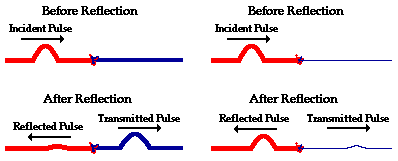
The more similar the medium, the more transmission that occurs.

These principles of reflection can be applied to sound waves. Though a sound wave does not consist of crests and troughs, they do consist of compressions and rarefactions. If a sound wave is traveling through a cylindrical tube, it will eventually come to the end of the tube. The end of the tube represents a boundary between the enclosed air in the tube and the expanse of air outside of the tube. Upon reaching the end of the tube, the sound wave will undergo partial reflection and partial transmission. That is, a portion of the energy carried by the sound wave will pass across the boundary and out of the tube (transmission) and a portion of the energy carried by the sound wave will reflect off the boundary, remain in the tube and travel in the opposite direction (reflection). The reflected pulse off the end of the tube can then interfere with any subsequent incident pulses that are traveling in the opposite direction. If the disturbances within the tube are the result of perpetual waves of a constant frequency, then interference between the incident and reflected waves will occur along the length of the tube. The reflection behavior of sound waves and the subsequent interference that occurs will become important in Lesson 5 during the discussion of musical instruments. Many musical instruments operate as the result of sound waves traveling back and forth inside of “tubes” or air columns.
The reflection of sound also becomes important to the design of concert halls and auditoriums. The acoustics of sound must be considered in the design of such buildings. The most important considerations include destructive interference and reverberations, both of which are the result of reflections of sound off the walls and ceilings. Designers attempt to reduce the severity of these problems by using building materials that reduce the amount of reflection and enhance the amount of transmission (or absorption) into the walls and ceilings. The most reflective materials are those that are smooth and hard; such materials are very dissimilar to air and thus reduce the amount of transmission and increase the amount of reflection. The best materials to use in the design of concert halls and auditoriums are those materials that are soft. For this reason, fiberglass and acoustic tile are used in such buildings rather than cement and brick.
D. Reflection, Refraction, and Diffraction
Like any wave, a sound wave doesn’t just stop when it reaches the end of the medium or when it encounters an obstacle in its path. Rather, a sound wave will undergo certain behaviors when it encounters the end of the medium or an obstacle. Possible behaviors include reflection off the obstacle, diffraction around the obstacle, and transmission (accompanied by refraction) into the obstacle or new medium. In this part of Lesson 3, we will investigate behaviors that have already been discussed in a previous unit and apply them towards the reflection, diffraction, and refraction of sound waves.
Reflection and Transmission of Sound
When a wave reaches the boundary between one medium another medium, a portion of the wave undergoes reflection and a portion of the wave undergoes transmission across the boundary. As discussed in the previous part of Lesson 3, the amount of reflection is dependent upon the dissimilarity of the two media. For this reason, acoustically minded builders of auditoriums and concert halls avoid the use of hard, smooth materials in the construction of their inside halls. A hard material such as concrete is as dissimilar as can be to the air through which the sound moves; subsequently, most of the sound wave is reflected by the walls and little is absorbed. Walls and ceilings of concert halls are made softer materials such as fiberglass and acoustic tiles. These materials are more similar to air than concrete and thus have a greater ability to absorb sound. This gives the room more pleasing acoustic properties.
Reflection of sound waves off of surfaces can lead to one of two phenomena – an echo or a reverberation. A reverberation often occurs in a small room with height, width, and length dimensions of approximately 17 meters or less. Why the magical 17 meters? The effect of a particular sound wave upon the brain endures for more than a tiny fraction of a second; the human brain keeps a sound in memory for up to 0.1 seconds. If a reflected sound wave reaches the ear within 0.1 seconds of the initial sound, then it seems to the person that the sound is prolonged. The reception of multiple reflections off of walls and ceilings within 0.1 seconds of each other causes reverberations – the prolonging of a sound. Since sound waves travel at about 340 m/s at room temperature, it will take approximately 0.1 s for a sound to travel the length of a 17 meter room and back, thus causing a reverberation (recall from Lesson 2, t = d/v = (34 m)/(340 m/s) = 0.1 s). This is why reverberations are common in rooms with dimensions of approximately 17 meters or less. Perhaps you have observed reverberations when talking in an empty room, when honking the horn while driving through a highway tunnel or underpass, or when singing in the shower. In auditoriums and concert halls, reverberations occasionally occur and lead to the displeasing garbling of a sound.
But reflection of sound waves in auditoriums and concert halls do not always lead to displeasing results, especially if the reflections are designed right. Smooth walls have a tendency to direct sound waves in a specific direction. Subsequently the use of smooth walls in an auditorium will cause spectators to receive a large amount of sound from one location along the wall; there would be only one possible path by which sound waves could travel from the speakers to the listener. The auditorium would not seem to be as lively and full of sound. Rough walls tend to diffuse sound, reflecting it in a variety of directions. This allows a spectator to perceive sounds from every part of the room, making it seem lively and full. For this reason, auditorium and concert hall designers prefer construction materials that are rough rather than smooth.

Reflection of sound waves also leads to echoes. Echoes are different than reverberations. Echoes occur when a reflected sound wave reaches the ear more than 0.1 seconds after the original sound wave was heard. If the elapsed time between the arrivals of the two sound waves is more than 0.1 seconds, then the sensation of the first sound will have died out. In this case, the arrival of the second sound wave will be perceived as a second sound rather than the prolonging of the first sound. There will be an echo instead of a reverberation.
Reflection of sound waves off of surfaces is also affected by the shape of the surface. As mentioned of water waves in Unit 10, flat or plane surfaces reflect sound waves in such a way that the angle at which the wave approaches the surface equals the angle at which the wave leaves the surface. This principle will be extended to the reflective behavior of light waves off of plane surfaces in great detail in Unit 13 of The Physics Classroom. Reflection of sound waves off of curved surfaces leads to a more interesting phenomenon. Curved surfaces with a parabolic shape have the habit of focusing sound waves to a point. Sound waves reflecting off of parabolic surfaces concentrate all their energy to a single point in space; at that point, the sound is amplified. Perhaps you have seen a museum exhibit that utilizes a parabolic-shaped disk to collect a large amount of sound and focus it at a focal point. If you place your ear at the focal point, you can hear even the faintest whisper of a friend standing across the room. Parabolic-shaped satellite disks use this same principle of reflection to gather large amounts of electromagnetic waves and focus it at a point (where the receptor is located). Scientists have recently discovered some evidence that seems to reveal that a bull moose utilizes his antlers as a satellite disk to gather and focus sound. Finally, scientists have long believed that owls are equipped with spherical facial disks that can be maneuvered in order to gather and reflect sound towards their ears. The reflective behavior of light waves off curved surfaces will be studies in great detail in Unit 13 of The Physics Classroom Tutorial.
Diffraction of Sound Waves
Diffraction involves a change in direction of waves as they pass through an opening or around a barrier in their path. The diffraction of water waves was discussed in Unit 10 of The Physics Classroom Tutorial. In that unit, we saw that water waves have the ability to travel around corners, around obstacles and through openings. The amount of diffraction (the sharpness of the bending) increases with increasing wavelength and decreases with decreasing wavelength. In fact, when the wavelength of the wave is smaller than the obstacle or opening, no noticeable diffraction occurs.
Diffraction of sound waves is commonly observed; we notice sound diffracting around corners or through door openings, allowing us to hear others who are speaking to us from adjacent rooms. Many forest-dwelling birds take advantage of the diffractive ability of long-wavelength sound waves. Owls for instance are able to communicate across long distances due to the fact that their long-wavelength hoots are able to diffract around forest trees and carry farther than the short-wavelength tweets of songbirds. Low-pitched (long wavelength) sounds always carry further than high-pitched (short wavelength) sounds.
Scientists have recently learned that elephants emit infrasonic waves of very low frequency to communicate over long distances to each other. Elephants typically migrate in large herds that may sometimes become separated from each other by distances of several miles. Researchers who have observed elephant migrations from the air and have been both impressed and puzzled by the ability of elephants at the beginning and the end of these herds to make extremely synchronized movements. The matriarch at the front of the herd might make a turn to the right, which is immediately followed by elephants at the end of the herd making the same turn to the right. These synchronized movements occur despite the fact that the elephants’ vision of each other is blocked by dense vegetation. Only recently have they learned that the synchronized movements are preceded by infrasonic communication. While low wavelength sound waves are unable to diffract around the dense vegetation, the high wavelength sounds produced by the elephants have sufficient diffractive ability to communicate long distances.
Bats use high frequency (low wavelength) ultrasonic waves in order to enhance their ability to hunt. The typical prey of a bat is the moth – an object not much larger than a couple of centimeters. Bats use ultrasonic echolocation methods to detect the presence of bats in the air. But why ultrasound? The answer lies in the physics of diffraction. As the wavelength of a wave becomes smaller than the obstacle that it encounters, the wave is no longer able to diffract around the obstacle, instead the wave reflects off the obstacle. Bats use ultrasonic waves with wavelengths smaller than the dimensions of their prey. These sound waves will encounter the prey, and instead of diffracting around the prey, will reflect off the prey and allow the bat to hunt by means of echolocation. The wavelength of a 50 000 Hz sound wave in air (speed of approximately 340 m/s) can be calculated as follows
wavelength = speed/frequency
wavelength = (340 m/s)/(50 000 Hz)
wavelength = 0.0068 m
The wavelength of the 50 000 Hz sound wave (typical for a bat) is approximately 0.7 centimeters, smaller than the dimensions of a typical moth.
Refraction of Sound Waves
[Text Box]Refraction of waves involves a change in the direction of waves as they pass from one medium to another. Refraction, or bending of the path of the waves, is accompanied by a change in speed and wavelength of the waves. So if the media (or its properties) are changed, the speed of the wave is changed. Thus, waves passing from one medium to another will undergo refraction. Refraction of sound waves is most evident in situations in which the sound wave passes through a medium with gradually varying properties. For example, sound waves are known to refract when traveling over water. Even though the sound wave is not exactly changing media, it is traveling through a medium with varying properties; thus, the wave will encounter refraction and change its direction. Since water has a moderating effect upon the temperature of air, the air directly above the water tends to be cooler than the air far above the water. Sound waves travel slower in cooler air than they do in warmer air. For this reason, the portion of the wavefront directly above the water is slowed down, while the portion of the wavefronts far above the water speeds ahead. Subsequently, the direction of the wave changes, refracting downwards towards the water. This is depicted in the diagram at the right.
…………………………………………………………………………………………………………………………………………………………………………………………………………………………………………………………………………………………………………………………………………………………………………………………………………………………………………………………………………………………………………………………………………………………………………………………………………………………………
Lesson 4 – Resonance and Standing Waves
a. Natural Frequency

As has been previously mentioned in this unit, a sound wave is created as a result of a vibrating object. The vibrating object is the source of the disturbance that moves through the medium. The vibrating object that creates the disturbance could be the vocal cords of a person, the vibrating string and soundboard of a guitar or violin, the vibrating tines of a tuning fork, or the vibrating diaphragm of a radio speaker. Any object that vibrates will create a sound. The sound could be musical or it could be noisy; but regardless of its quality, the sound wave is created by a vibrating object.
Nearly all objects, when hit or struck or plucked or strummed or somehow disturbed, will vibrate. If you drop a meter stick or pencil on the floor, it will begin to vibrate. If you pluck a guitar string, it will begin to vibrate. If you blow over the top of a pop bottle, the air inside will vibrate. When each of these objects vibrates, they tend to vibrate at a particular frequency or a set of frequencies. The frequency or frequencies at which an object tends to vibrate with when hit, struck, plucked, strummed or somehow disturbed is known as the natural frequency of the object. If the amplitudes of the vibrations are large enough and if natural frequency is within the human frequency range, then the vibrating object will produce sound waves that are audible.
All objects have a natural frequency or set of frequencies at which they vibrate. The quality or timbre of the sound produced by a vibrating object is dependent upon the natural frequencies of the sound waves produced by the objects. Some objects tend to vibrate at a single frequency and they are often said to produce a pure tone. A flute tends to vibrate at a single frequency, producing a very pure tone. Other objects vibrate and produce more complex waves with a set of frequencies that have a whole number mathematical relationship between them; these are said to produce a rich sound. A tuba tends to vibrate at a set of frequencies that are mathematically related by whole number ratios; it produces a rich tone. Still other objects will vibrate at a set of multiple frequencies that have no simple mathematical relationship between them. These objects are not musical at all and the sounds that they create could be described as noise. When a meter stick or pencil is dropped on the floor, it vibrates with a number of frequencies, producing a complex sound wave that is clanky and noisy.

Factors Affecting the Natural Frequency
The actual frequency at which an object will vibrate at is determined by a variety of factors. Each of these factors will either affect the wavelength or the speed of the object. Since
frequency = speed/wavelength
an alteration in either speed or wavelength will result in an alteration of the natural frequency. The role of a musician is to control these variables in order to produce a given frequency from the instrument that is being played. Consider a guitar as an example. There are six strings, each having a different linear density (the wider strings are more dense on a per meter basis), a different tension (which is controllable by the guitarist), and a different length (also controllable by the guitarist). The speed at which waves move through the strings is dependent upon the properties of the medium - in this case the tightness (tension) of the string and the linear density of the strings. Changes in these properties would affect the natural frequency of the particular string. The vibrating portion of a particular string can be shortened by pressing the string against one of the frets on the neck of the guitar. This modification in the length of the string would affect the wavelength of the wave and in turn the natural frequency at which a particular string vibrates at. Controlling the speed and the wavelength in this manner allows a guitarist to control the natural frequencies of the vibrating object (a string) and thus produce the intended musical sounds. The same principles can be applied to any string instrument – whether it is the harp, harpsichord, violin or guitar.
As another example, consider the trombone with its long cylindrical tube that is bent upon itself twice and ends in a flared end. The trombone is an example of a wind instrument. The tube of any wind instrument acts as a container for a vibrating air column. The air inside the tube will be set into vibration by a vibrating reed or the vibrations of a musician’s lips against a mouthpiece. While the speed of sound waves within the air column is not alterable by the musician (they can only be altered by changes in room temperature), the length of the air column is. For a trombone, the length is altered by pushing the tube outward away from the mouthpiece to lengthen it or pulling it in to shorten it. This causes the length of the air column to be changed, and subsequently changes the wavelength of the waves it produces. And of course, a change in wavelength will result in a change in the frequency. So the natural frequency of a wind instrument such as the trombone is dependent upon the length of the air column of the instrument. The same principles can be applied to any similar instrument (tuba, flute, wind chime, organ pipe, clarinet, or pop bottle) whose sound is produced by vibrations of air within a tube.

There were a variety of classroom demonstrations (some of which are fun and some of which are corny) that illustrate the idea of natural frequencies and their modification. A pop bottle can be partly filled with water, leaving a volume of air inside that is capable of vibrating. When a person blows over the top of the bottle, the air inside is set into vibrational motion; turbulence above the lip of the bottle creates disturbances within the bottle. These vibrations result in a sound wave that is audible to students. Of course, the frequency can be modified by altering the volume of the air column (adding or removing water), which changes the wavelength and in turn the frequency. The principle is similar to the frequency-wavelength relation of air columns; a smaller volume of air inside the bottle means a shorter wavelength and a higher frequency.
A toilet paper roll orchestra can be created from different lengths of toilet paper rolls (or wrapping paper rolls). The rolls will vibrate with different frequencies when struck against a student’s head. A properly selected set of rolls will result in the production of sounds that are capable of a Tony Award rendition of “Mary Had a Little Lamb.”
Maybe you are familiar with the popular water goblet prom trick that is often demonstrated in a Physics class. Obtain a water goblet and clean your fingers. Then gently slide your finger over the rim of the water goblet. If you are fortunate enough, you might be able to set the goblet into vibration by means of slip-stick friction. (It is not necessary to use a crystal goblet. It is often said that crystal goblets work better; but the trick is just as easily performed with clean fingers and an inexpensive goblet.) Like a violin bowstring being pulled across a violin string, the finger sticks to the glass molecules, pulling them apart at a given point until the tension becomes so great. The finger then slips off the glass and subsequently finds another microscopic surface to stick to; the finger pulls the molecules at that surface, slips and then sticks at another location. This process of stick-slip friction occurring at a high frequency is sufficient to set the molecules of the glass into vibration at its natural frequency. The result is enough to impress your dinner guests. Try it at home!!
Perhaps you have seen a pendulum bob vibrating back and forth about its equilibrium position. While a pendulum does not produce a sound when it oscillates, it does illustrate an important principle. A pendulum consisting of a longer string vibrates with a longer period and thus a lower frequency. Once more, there is an inverse relationship between the length of the vibrating object and the natural frequency at which the object vibrates. This very relationship carries over to any vibrating instrument – whether it is a guitar string, a xylophone, a pop bottle instrument, or a kettledrum.
To conclude, all objects have a natural frequency or set of frequencies at which they vibrate when struck, plucked, strummed or somehow disturbed. The actual frequency is dependent upon the properties of the material the object is made of (this affects the speed of the wave) and the length of the material (this affects the wavelength of the wave). It is the goal of musicians to find instruments that possess the ability to vibrate with sets of frequencies that are musically sounding (i.e., mathematically related by simple whole number ratios) and to vary the lengths and (if possible) properties to create the desired sounds.https://ads.freestar.com/?utm_campaign=branding&utm_medium=lazyLoad&utm_source=physicsclassroom.com&utm_content=physicsclassroom_incontent_3
Watch It! :A physics instructor makes a water goblet sing at its natural frequency.
b. Forced Vibration

Musical instruments and other objects are set into vibration at their natural frequency when a person hits, strikes, strums, plucks or somehow disturbs the object. For instance, a guitar string is strummed or plucked; a piano string is hit with a hammer when a pedal is played; and the tines of a tuning fork are hit with a rubber mallet. Whatever the case, a person or thing puts energy into the instrument by direct contact with it. This input of energy disturbs the particles and forces the object into vibrational motion – at its natural frequency.
If you were to take a guitar string and stretch it to a given length and a given tightness and have a friend pluck it, you would hear a noise; but the noise would not even be close in comparison to the loudness produced by an acoustic guitar. On the other hand, if the string is attached to the sound box of the guitar, the vibrating string is capable of forcing the sound box into vibrating at that same natural frequency. The sound box in turn forces air particles inside the box into vibrational motion at the same natural frequency as the string. The entire system (string, guitar, and enclosed air) begins vibrating and forces surrounding air particles into vibrational motion. The tendency of one object to force another adjoining or interconnected object into vibrational motion is referred to as a forced vibration. In the case of the guitar string mounted to the sound box, the fact that the surface area of the sound box is greater than the surface area of the string means that more surrounding air particles will be forced into vibration. This causes an increase in the amplitude and thus loudness of the sound.
This same principle of a forced vibration is often demonstrated in a Physics classroom using a tuning fork. If the tuning fork is held in your hand and hit with a rubber mallet, a sound is produced as the tines of the tuning fork set surrounding air particles into vibrational motion. The sound produced by the tuning fork is barely audible to students in the back rows of the room. However, if the tuning fork is set upon the whiteboard panel or the glass panel of the overhead projector, the panel begins vibrating at the same natural frequency of the tuning fork. The tuning fork forces surrounding glass (or vinyl) particles into vibrational motion. The vibrating whiteboard or overhead projector panel in turn forces surrounding air particles into vibrational motion and the result is an increase in the amplitude and thus loudness of the sound. This principle of forced vibration explains why demonstration tuning forks are mounted on a sound box, why a commercial music box mechanism is mounted on a sounding board, why a guitar utilizes a sound box, and why a piano string is attached to a sounding board. A louder sound is always produced when an accompanying object of greater surface area is forced into vibration at the same natural frequency.
Resonance
Now consider a related situation that resembles another common Physics demonstration. Suppose that a tuning fork is mounted on a sound box and set upon the table; and suppose a second tuning fork/sound box system having the same natural frequency (say 256 Hz) is placed on the table near the first system. Neither of the tuning forks is vibrating. Suppose the first tuning fork is struck with a rubber mallet and the tines begin vibrating at its natural frequency – 256 Hz. These vibrations set its sound box and the air inside the sound box vibrating at the same natural frequency of 256 Hz. Surrounding air particles are set into vibrational motion at the same natural frequency of 256 Hz and every student in the classroom hears the sound. Then the tines of the tuning fork are grabbed to prevent their vibration and remarkably the sound of 256 Hz is still being heard. Only now the sound is being produced by the second tuning fork – the one which wasn’t hit with the mallet. Amazing!! The demonstration is often repeated to assure that the same surprising results are observed. They are! What is happening?
In this demonstration, one tuning fork forces another tuning fork into vibrational motion at the same natural frequency. The two forks are connected by the surrounding air particles. As the air particles surrounding the first fork (and its connected sound box) begin vibrating, the pressure waves that it creates begin to impinge at a periodic and regular rate of 256 Hz upon the second tuning fork (and its connected sound box). The energy carried by this sound wave through the air is tuned to the frequency of the second tuning fork. Since the incoming sound waves share the same natural frequency as the second tuning fork, the tuning fork easily begins vibrating at its natural frequency. This is an example of resonance - when one object vibrating at the same natural frequency of a second object forces that second object into vibrational motion.
The result of resonance is always a large vibration. Regardless of the vibrating system, if resonance occurs, a large vibration results. This is often demonstrated in a Physics class with an odd-looking mechanical system resembling an inverted pendulum. The apparatus consists of three sets of two identical plastic bobs mounted on a very elastic metal pole, which are in turn mounted to a metal bar. Each metal pole and attached bob has a different length, thus giving it a different natural frequency of vibration. The bobs are often color-coded to distinguish between them; they are colored red, blue and green (a set of three colors that will be significant later in The Physics Classroom Tutorial). The red bobs are mounted on the longer poles and they have the lowest natural frequency of vibration. The blue bobs are mounted on the shorter poles and have the highest natural frequency of vibration. (Note the length-wavelength-frequency relationship that was discussed earlier.) When the red bob is disturbed, it begins vibrating at its natural frequency. This in turn forces the attached bar to vibrate at the same frequency; and this forces the other attached red bob into vibrating at the same natural frequency. This is resonance – one bob vibrating at a given frequency forcing a second object with the same natural frequency into vibrational motion. While the green and the blue bobs were disturbed by the vibrations transmitted through the metal bar, only the red bob would resonate. This is because the frequency of the first red bob is tuned to the frequency of the second red bob; they share the same natural frequency. The result is that the second red bob begins vibrating with a huge amplitude.
Watch It!
Another common classroom demonstration of resonance involves a plastic tube containing an air column. The length of the air column was adjusted by raising and lowering a reservoir of water (dyed red). The raising and lowering of the reservoir adjusts the height of water in the open-air tube, and thus adjusts the length of the air column inside the tube. As the length of the air column is decreased, the natural frequency of the air column is increased. (Again note the length-wavelength-frequency relationship that was discussed earlier.) While adjusting the height of the liquid in the tube, a vibrating tuning fork is held above the air column of the tube. When the natural frequency of the air column is tuned to the frequency of the vibrating tuning fork, resonance occurs and a loud sound results. Quite amazingly, the vibrating tuning fork forces air particles within the air column into vibrational motion. Once more in this resonance situation, the tuning fork and the air column share the same vibrational frequency.
In conclusion, resonance occurs when two interconnected objects share the same vibrational frequency. When one of the objects is vibrating, it forces the second object into vibrational motion. The result is a large vibration. And if a sound wave within the audible range of human hearing is produced, a loud sound is heard.
C.Standing Wave Patterns

As mentioned earlier, all objects have a frequency or set of frequencies with which they naturally vibrate when struck, plucked, strummed or somehow disturbed. Each of the natural frequencies at which an object vibrates is associated with a standing wave pattern. When an object is forced into resonance vibrations at one of its natural frequencies, it vibrates in a manner such that a standing wave is formed within the object. The topic of standing wave patterns was introduced in Unit 10 of The Physics Classroom. In that unit, a standing wave pattern was described as a vibrational pattern created within a medium when the vibrational frequency of a source causes reflected waves from one end of the medium to interfere with incident waves from the source. The result of the interference is that specific points along the medium appear to be standing still while other points vibrated back and forth. Such patterns are only created within the medium at specific frequencies of vibration. These frequencies are known as harmonic frequencies or merely harmonics. At any frequency other than a harmonic frequency, the interference of reflected and incident waves results in a disturbance of the medium that is irregular and non-repeating.
Natural Frequencies and Vibrational Patterns
So the natural frequencies of an object are merely the harmonic frequencies at which standing wave patterns are established within the object. These standing wave patterns represent the lowest energy vibrational modes of the object. While there are countless ways by which an object can vibrate (each associated with a specific frequency), objects favor only a few specific modes or patterns of vibrating. The favored modes (patterns) of vibration are those that result in the highest amplitude vibrations with the least input of energy. Objects favor these natural modes of vibration because they are representative of the patterns that require the least amount of energy. Objects are most easily forced into resonance vibrations when disturbed at frequencies associated with these natural frequencies.
The wave pattern associated with the natural frequencies of an object is characterized by points that appear to be standing still. For this reason, the pattern is often called a ”standing wave pattern.” The points in the pattern that are standing still are referred to as nodal points or nodal positions. These positions occur as the result of the destructive interference of incident and reflected waves. Each nodal point is surrounded by antinodal points, creating an alternating pattern of nodal and antinodal points. Such patterns were introduced in Unit 10 of The Physics Classroom Tutorial. In this unit, we will elaborate on the essential characteristics and the causes of standing wave patterns and relate these patterns to the vibrations of musical instruments.
Chladni Plates
A common Physics demonstration utilizes a square metal plate (known as a Chladni plate), a violin bow and salt. The plate is securely fastened to a table using a nut and bolt. The nut and bolt are clamped to the center of the square plate, preventing that section from vibrating. Salt (or sand) is sprinkled upon the plate in an irregular pattern. Then the violin bow is used to induce vibrations within the plate; the plate is strummed and begins vibrating. And then the magic occurs. A high-pitched pure tone is sounded out as the plate vibrates. And, remarkably (as is often the case in a physics class), the salt upon the plate begins vibrating and forms a pattern upon the plate. As we know, all objects (even a silly little metal plate) have a set of natural frequencies at which they vibrate; and each frequency is associated with a standing wave pattern. The pattern formed by the salt on the plate is the standing wave pattern associated with one of the natural frequencies of the Chladni plate. As the plate vibrates, the salt begins to vibrate and tumble about the plate until it reaches points along the plate that are not vibrating. Subsequently, the salt finally comes to rest along the nodal positions. The diagrams at the right show two of the most common standing wave patterns for the Chladni plates. The white lines represent the salt locations (nodal positions). Observe in the diagram that each pattern is characterized by nodal positions in the corners of the square plate and in the center of the plate. For these two particular vibrational modes, those positions are unable to move. Being unable to move, they become nodal points – points of no displacement.

Flicker Physics Photo
Salt is sprinkled onto a metal plate. The plate is strummed with a violin bow and set into vibration. The salt crystals vibrate about the plate until they settle onto positions of nodes (points of no despacement). Several patterns can be obtained, each associated with a unique frequency of vibrations. These standing wave patterns are known as Chladni patterns, named in honor of a 19th century German physicist who advanced our understanding of acoustics and the physics of music.

Standing Wave Patterns for Vibrating Strings
The diagram below depicts one of the natural patterns of vibrations for a guitar string. In the pattern, you will note that there are certain positions along the string (the medium) that appear to be standing still. These positions are referred to as nodes and are labeled on the diagram. In between each nodal position, there are other positions that appear to be vibrating back and forth between a large upward displacement to a large downward displacement. These points are referred to as antinodes and are also labeled on the diagram. There is an alternating pattern of nodal and antinodal positions in a standing wave pattern.

Because the antinodal positions along the guitar string are vibrating back and forth from a large upward displacement to a large downward displacement, the standing wave pattern is often depicted by a diagram such as that shown below.

The pattern above is not the only pattern of vibration for a guitar string. There are a variety of patterns by which the guitar string could naturally vibrate. Each pattern is associated with one of the natural frequencies of the guitar strings. Three other patterns are shown in the diagrams at the right. Each standing wave pattern is referred to as a harmonic of the instrument (in this case, the guitar string). The three diagrams at the right represent the standing wave patterns for the first, second, and third harmonics of a guitar string. (Harmonics will be discussed in more detail in the next section of this lesson.)
There are a variety of other low energy vibrational patterns that could be established in the string. For guitar strings, each pattern is characterized by some basic traits:
- There is an alternating pattern of nodes and antinodes.
- There are either a half-number or a whole number of waves within the pattern established on the string.
- Nodal positions (points of no displacement) are established at the ends of the string where the string is clamped down in a fixed position.
- One pattern is related to the next pattern by the addition (or subtraction) of one or more nodes (and antinodes).
The standing wave patterns for other musical instruments share some of these same or at least similar traits. These patterns will be discussed in more detail in Lesson 5 of this unit.
| 1st Harmonic | 2nd Harmonic | 3rd Harmonic |
Watch It!
A physics instructor demonstrates and explains the formation of a longitudinal standing wave in a spring.
We Would Like to Suggest …
Why just read about it and when you could be interacting with it? Interact – that’s exactly what you do when you use one of The Physics Classroom’s Interactives. We would like to suggest that you combine the reading of this page with the use of our Standing Wave Patterns Interactive. You can find it in the Physics Interactives section of our website. The Standing Wave Patterns Interactive provides the learner an environment for exploring the formation of standing waves, standing wave patterns, and mathematical relationships for standing wave patterns.
D. Fundamental Frequency and Harmonics

Previously in Lesson 4, it was mentioned that when an object is forced into resonance vibrations at one of its natural frequencies, it vibrates in a manner such that a standing wave pattern is formed within the object. Whether it is a guitar sting, a Chladni plate, or the air column enclosed within a trombone, the vibrating medium vibrates in such a way that a standing wave pattern results. Each natural frequency that an object or instrument produces has its own characteristic vibrational mode or standing wave pattern. These patterns are only created within the object or instrument at specific frequencies of vibration; these frequencies are known as harmonic frequencies, or merely harmonics. At any frequency other than a harmonic frequency, the resulting disturbance of the medium is irregular and non-repeating. For musical instruments and other objects that vibrate in regular and periodic fashion, the harmonic frequencies are related to each other by simple whole number ratios. This is part of the reason why such instruments sound pleasant. We will see in this part of Lesson 4 why these whole number ratios exist for a musical instrument.
Recognizing the Length-Wavelength Relationship
First, consider a guitar string vibrating at its natural frequency or harmonic frequency. Because the ends of the string are attached and fixed in place to the guitar’s structure (the bridge at one end and the frets at the other), the ends of the string are unable to move. Subsequently, these ends become nodes – points of no displacement. In between these two nodes at the end of the string, there must be at least one antinode. The most fundamental harmonic for a guitar string is the harmonic associated with a standing wave having only one antinode positioned between the two nodes on the end of the string. This would be the harmonic with the longest wavelength and the lowest frequency. The lowest frequency produced by any particular instrument is known as the fundamental frequency. The fundamental frequency is also called the first harmonic of the instrument. The diagram at the right shows the first harmonic of a guitar string. If you analyze the wave pattern in the guitar string for this harmonic, you will notice that there is not quite one complete wave within the pattern. A complete wave starts at the rest position, rises to a crest, returns to rest, drops to a trough, and finally returns to the rest position before starting its next cycle. (Caution: the use of the words crest and trough to describe the pattern are only used to help identify the length of a repeating wave cycle. A standing wave pattern is not actually a wave, but rather a pattern of a wave. Thus, it does not consist of crests and troughs, but rather nodes and antinodes. The pattern is the result of the interference of two waves to produce these nodes and antinodes.) In this pattern, there is only one-half of a wave within the length of the string. This is the case for the first harmonic or fundamental frequency of a guitar string. The diagram below depicts this length-wavelength relationship for the fundamental frequency of a guitar string.

The second harmonic of a guitar string is produced by adding one more node between the ends of the guitar string. And of course, if a node is added to the pattern, then an antinode must be added as well in order to maintain an alternating pattern of nodes and antinodes. In order to create a regular and repeating pattern, that node must be located midway between the ends of the guitar string. This additional node gives the second harmonic a total of three nodes and two antinodes. The standing wave pattern for the second harmonic is shown at the right. A careful investigation of the pattern reveals that there is exactly one full wave within the length of the guitar string. For this reason, the length of the string is equal to the length of the wave.
The third harmonic of a guitar string is produced by adding two nodes between the ends of the guitar string. And of course, if two nodes are added to the pattern, then two antinodes must be added as well in order to maintain an alternating pattern of nodes and antinodes. In order to create a regular and repeating pattern for this harmonic, the two additional nodes must be evenly spaced between the ends of the guitar string. This places them at the one-third mark and the two-thirds mark along the string. These additional nodes give the third harmonic a total of four nodes and three antinodes. The standing wave pattern for the third harmonic is shown at the right. A careful investigation of the pattern reveals that there is more than one full wave within the length of the guitar string. In fact, there are three-halves of a wave within the length of the guitar string. For this reason, the length of the string is equal to three-halves the length of the wave. The diagram below depicts this length-wavelength relationship for the fundamental frequency of a guitar string.

After a discussion of the first three harmonics, a pattern can be recognized. Each harmonic results in an additional node and antinode, and an additional half of a wave within the string. If the number of waves in a string is known, then an equation relating the wavelength of the standing wave pattern to the length of the string can be algebraically derived.

This information is summarized in the table below.
| Harmonic # | # of Waves in String | # of Nodes | # of Anti- nodes | Length- Wavelength Relationship |
| 1 | 1/2 | 2 | 1 | Wavelength = (2/1)*L |
| 2 | 1 or 2/2 | 3 | 2 | Wavelength = (2/2)*L |
| 3 | 3/2 | 4 | 3 | Wavelength = (2/3)*L |
| 4 | 2 or 4/2 | 5 | 4 | Wavelength = (2/4)*L |
| 5 | 5/2 | 6 | 5 | Wavelength = (2/5)*L |
The above discussion develops the mathematical relationship between the length of a guitar string and the wavelength of the standing wave patterns for the various harmonics that could be established within the string. Now these length-wavelength relationships will be used to develop relationships for the ratio of the wavelengths and the ratio of the frequencies for the various harmonics played by a string instrument (such as a guitar string).
Determining the Harmonic Frequencies
Consider an 80-cm long guitar string that has a fundamental frequency (1st harmonic) of 400 Hz. For the first harmonic, the wavelength of the wave pattern would be two times the length of the string (see table above); thus, the wavelength is 160 cm or 1.60 m. The speed of the standing wave can now be determined from the wavelength and the frequency. The speed of the standing wave is
speed = frequency • wavelength
speed = 400 Hz • 1.6 m
speed = 640 m/s
This speed of 640 m/s corresponds to the speed of any wave within the guitar string. Since the speed of a wave is dependent upon the properties of the medium (and not upon the properties of the wave), every wave will have the same speed in this string regardless of its frequency and its wavelength. So the standing wave pattern associated with the second harmonic, third harmonic, fourth harmonic, etc. will also have this speed of 640 m/s. A change in frequency or wavelength will NOT cause a change in speed.
Using the table above, the wavelength of the second harmonic (denoted by the symbol λ2) would be 0.8 m (the same as the length of the string). The speed of the standing wave pattern (denoted by the symbol v) is still 640 m/s. Now the wave equation can be used to determine the frequency of the second harmonic (denoted by the symbol f2).
speed = frequency • wavelength
frequency = speed/wavelength
f2 = v / λ2
f2 = (640 m/s)/(0.8 m)
f2 = 800 Hz
This same process can be repeated for the third harmonic. Using the table above, the wavelength of the third harmonic (denoted by the symbol λ3) would be 0.533 m (two-thirds of the length of the string). The speed of the standing wave pattern (denoted by the symbol v) is still 640 m/s. Now the wave equation can be used to determine the frequency of the third harmonic (denoted by the symbol f3).
speed = frequency • wavelength
frequency = speed/wavelength
f3 = v / λ3
f3 = (640 m/s)/(0.533 m)
f3 = 1200 Hz
Now if you have been following along, you will have recognized a pattern. The frequency of the second harmonic is two times the frequency of the first harmonic. The frequency of the third harmonic is three times the frequency of the first harmonic. The frequency of the nth harmonic (where n represents the harmonic # of any of the harmonics) is n times the frequency of the first harmonic. In equation form, this can be written as
fn = n • f1
The inverse of this pattern exists for the wavelength values of the various harmonics. The wavelength of the second harmonic is one-half (1/2) the wavelength of the first harmonic. The wavelength of the third harmonic is one-third (1/3) the wavelength of the first harmonic. And the wavelength of the nth harmonic is one-nth (1/n) the wavelength of the first harmonic. In equation form, this can be written as
λn = (1/n) • λ1
These relationships between wavelengths and frequencies of the various harmonics for a guitar string are summarized in the table below.
| Harmonic # | Frequency (Hz) | Wavelength (m) | Speed (m/s) | fn / f1 | λn / λ1 |
| 1 | 400 | 1.60 | 640 | 1 | 1/1 |
| 2 | 800 | 0.800 | 640 | 2 | 1/2 |
| 3 | 1200 | 0.533 | 640 | 3 | 1/3 |
| 4 | 1600 | 0.400 | 640 | 4 | 1/4 |
| 5 | 2000 | 0.320 | 640 | 5 | 1/5 |
| n | n * 400 | (2/n)*(0.800) | 640 | n | 1/n |
The table above demonstrates that the individual frequencies in the set of natural frequencies produced by a guitar string are related to each other by whole number ratios. For instance, the first and second harmonics have a 2:1 frequency ratio; the second and the third harmonics have a 3:2 frequency ratio; the third and the fourth harmonics have a 4:3 frequency ratio; and the fifth and the fourth harmonic have a 5:4 frequency ratio. When the guitar is played, the string, sound box and surrounding air vibrate at a set of frequencies to produce a wave with a mixture of harmonics. The exact composition of that mixture determines the timbre or quality of sound that is heard. If there is only a single harmonic sounding out in the mixture (in which case, it wouldn’t be a mixture), then the sound is rather pure-sounding. On the other hand, if there are a variety of frequencies sounding out in the mixture, then the timbre of the sound is rather rich in quality.
In Lesson 5, these same principles of resonance and standing waves will be applied to other types of instruments besides guitar strings.
Investigate!
The harmonics of an instrument, when played together, sound good. Use the Timbre widget below to investigate this principle. Use the frequencies provided and try some combinations of your own.
| Timbre | ||
| Top of Form Enter the frequency of any four sounds. Then click on the Mix Em and Play button to see the wave pattern and hear the sound. Frequency 1 (Hz) [Control] Frequency 2 (Hz) [Control] Frequency 3 (Hz) [Control] Frequency 4 (Hz) [Control] Mix Em and Play Bottom of Form | ||
We Would Like to Suggest …
Why just read about it and when you could be interacting with it? Interact – that’s exactly what you do when you use one of The Physics Classroom’s Interactives. We would like to suggest that you combine the reading of this page with the use of our Standing Wave Patterns Interactive. You can find it in the Physics Interactives section of our website. The Standing Wave Patterns Interactive provides the learner an environment for exploring the formation of standing waves, standing wave patterns, and mathematical relationships for standing wave patterns.
Visit: Standing Wave Patterns Interactive
Check Your Understanding
1. Anna Litical cuts short sections of PVC pipe into different lengths and mounts them in putty on the table. The PVC pipes form closed-end air columns that sound out at different frequencies when she blows over the top of them. The actual frequency of vibration is inversely proportional to the wavelength of the sound; and thus, the frequency of vibration is inversely proportional to the length of air inside the tubes. Express your understanding of this resonance phenomenon by filling in the following table.

See Answer


The speed of wave is not dependent upon wave properties such as wavelength and frequency. Thus, the speed of the sound wave is 340 m/s for each of the four pipes.
For Pipe C, the frequency can be determined from knowledge of the speed and the wavelength using the wave equation: v = f • λ where λ is the wavelength. First, rearrange the equation. Then substitute and solve as shown below.
f = v / λ = (340 m/s) / (0.64 m) = 531 Hz
For all four pipes, the length of the air column inside the pipe is one-fourth the wavelength of the wave. This is evident when looking at the length – wavelength relationships for Pipes A and B. Put in equation form: L = 0.25 • λ where λ is the wavelength. For Pipe C:
L = 0.25 • λ = 0.25 • (0.64 m) = 0.16 m
For Pipe D, the determination of the wavelength demands that the L = 0.25 • λ equation be rearranged.
λ = 4 • L = 4 • 0.20 m = 0.80 m
2. In a rare moment of artistic brilliance, a Physics teacher pulls out his violin bow and strokes a square metal plate to produce vibrations within the plate. Often times, he places salt upon the plate and observes the standing wave patterns established in the plate as it vibrates. Amazingly, the salt is aligned along the locations of the plate that are not vibrating and far from the locations of maximum vibration. The two most common standing wave patterns are illustrated at the right. Compare the wavelength of pattern A to the wavelength of pattern B. Suppose that the fundamental frequency of vibration is nearly 1200 Hz. Estimate the frequency of vibration of the plate when it vibrates in the second, third and fourth harmonics.

The frequencies of the various harmonics are multiples of the frequency of the first harmonic. Each harmonic frequency (fn) is given by the equation fn = n • f1 where n is the harmonic number and f1 is the frequency of the first harmonic.
f2 = 2 • f1 = 2400 Hz
f3 = 3 • f1 = 3600 Hz
f4 = 4 • f1 = 4800 H
3. When a tennis racket strikes a tennis ball, the racket begins to vibrate. There is a set of selected frequencies at which the racket will tend to vibrate. Each frequency in the set is characterized by a particular standing wave pattern. The diagrams below show the three of the more common standing wave patterns for the vibrations of a tennis racket.


Compare the wavelength of pattern A to the wavelength of pattern B. Make your comparison both qualitative and quantitative. Repeat for pattern C.
Answer:
Wavelength A is bigger than B which is bigger than C.In A, there is 1/4-th of a wave in the racket. In B, there is 3/4-ths of a wave in the racket. In C, there is 4/4-ths of a wave in the racket. Thus, the wave in Pattern A is 3 times the length of Wave in Pattern B and 4 times the length of wave in Pattern C
b. Compare the frequency of pattern A to the frequency of pattern B. Make your comparison both qualitative and quantitative. Repeat for pattern C.a

The frequency of C is bigger than B which is bigger than A.
In A, there is 1/4-th of a wave in the racket. In B, there is 3/4-ths of a wave in the racket. In C, there is 4/4-ths of a wave in the racket. Frequency and wavelength are inversely related. The longer the wavelength, the lower the frequency. Thus, wave B is 3 times the frequency of Wave A and wave C is 4 times the frequency of wave A.
c. When the racket vibrates as in pattern A, its frequency of vibration is approximately 30 Hz. Determine the frequency of vibration of the racket when it vibrates as in pattern B and pattern C.
Answer:
Following from the reasoning to the previous answer in part b of this question, wave B must have a frequency of 90 Hz and wave C must have a frequency of 120 Hz
[Text Box]
……………………………………………………………………………………………………………………………………………………………………………………………………………………………………………………………………………………………………………………………………………………………………………………………………………………………………………………………………………………………………………………………………………………………………………………………………………………………………………………………………………………………………………………………………………………………………………………………………………………………………………………………………………………………………………………………………………………………………………………………………………………………………………………………………………………………………………………………………………………………………………………………………………………………………………………………………………………………………………………………………………………………………
Lesson 5 – Physics of Musical Instruments
A. Resonance
The goal of Unit 11 of The Physics Classroom Tutorial is to develop an understanding of the nature, properties, behavior, and mathematics of sound and to apply this understanding to the analysis of music and musical instruments. Thus far in this unit, applications of sound wave principles have been made towards a discussion of beats, musical intervals, concert hall acoustics, the distinctions between noise and music, and sound production by musical instruments. In Lesson 5, the focus will be upon the application of mathematical relationships and standing wave concepts to musical instruments. Three general categories of instruments will be investigated: instruments with vibrating strings (which would include guitar strings, violin strings, and piano strings), open-end air column instruments (which would include the brass instruments such as the trombone and woodwinds such as the flute and the recorder), and closed-end air column instruments (which would include some organ pipe and the bottles of a pop bottle orchestra). A fourth category – vibrating mechanical systems (which includes all the percussion instruments) – will not be discussed. These instrument categories may be unusual to some; they are based upon the commonalities among their standing wave patterns and the mathematical relationships between the frequencies that the instruments produce.
Resonance

As was mentioned in Lesson 4, musical instruments are set into vibrational motion at their natural frequency when a person hits, strikes, strums, plucks or somehow disturbs the object. Each natural frequency of the object is associated with one of the many standing wave patterns by which that object could vibrate. The natural frequencies of a musical instrument are sometimes referred to as the harmonics of the instrument. An instrument can be forced into vibrating at one of its harmonics (with one of its standing wave patterns) if another interconnected object pushes it with one of those frequencies. This is known as resonance - when one object vibrating at the same natural frequency of a second object forces that second object into vibrational motion.
The word resonance comes from Latin and means to “resound” – to sound out together with a loud sound. Resonance is a common cause of sound production in musical instruments. One of our best models of resonance in a musical instrument is a resonance tube (a hollow cylindrical tube) partially filled with water and forced into vibration by a tuning fork. The tuning fork is the object that forced the air inside of the resonance tube into resonance. As the tines of the tuning fork vibrate at their own natural frequency, they created sound waves that impinge upon the opening of the resonance tube. These impinging sound waves produced by the tuning fork force air inside of the resonance tube to vibrate at the same frequency. Yet, in the absence of resonance, the sound of these vibrations is not loud enough to discern. Resonance only occurs when the first object is vibrating at the natural frequency of the second object. So if the frequency at which the tuning fork vibrates is not identical to one of the natural frequencies of the air column inside the resonance tube, resonance will not occur and the two objects will not sound out together with a loud sound. But the location of the water level can be altered by raising and lowering a reservoir of water, thus decreasing or increasing the length of the air column. As we have learned earlier, an increase in the length of a vibrational system (here, the air in the tube) increases the wavelength and decreases the natural frequency of that system. Conversely, a decrease in the length of a vibrational system decreases the wavelength and increases the natural frequency. So by raising and lowering the water level, the natural frequency of the air in the tube could be matched to the frequency at which the tuning fork vibrates. When the match is achieved, the tuning fork forces the air column inside of the resonance tube to vibrate at its own natural frequency and resonance is achieved. The result of resonance is always a big vibration – that is, a loud sound.
Another common physics demonstration that serves as an excellent model of resonance is the famous “singing rod” demonstration. A long hollow aluminum rod is held at its center. Being a trained musician, teacher reaches in a rosin bag to prepare for the event. Then with great enthusiasm, he/she slowly slides her hand across the length of the aluminum rod, causing it to sound out with a loud sound. This is an example of resonance. As the hand slides across the surface of the aluminum rod, slip-stick friction between the hand and the rod produces vibrations of the aluminum. The vibrations of the aluminum force the air column inside of the rod to vibrate at its natural frequency. The match between the vibrations of the air column and one of the natural frequencies of the singing rod causes resonance. The result of resonance is always a big vibration – that is, a loud sound.

The familiar sound of the sea that is heard when a seashell is placed up to your ear is also explained by resonance. Even in an apparently quiet room, there are sound waves with a range of frequencies. These sounds are mostly inaudible due to their low intensity. This so-called background noise fills the seashell, causing vibrations within the seashell. But the seashell has a set of natural frequencies at which it will vibrate. If one of the frequencies in the room forces air within the seashell to vibrate at its natural frequency, a resonance situation is created. And always, the result of resonance is a big vibration – that is, a loud sound. In fact, the sound is loud enough to hear. So the next time you hear the sound of the sea in a seashell, remember that all that you are hearing is the amplification of one of the many background frequencies in the room.https://ads.freestar.com/?utm_campaign=branding&utm_medium=lazyLoad&utm_source=physicsclassroom.com&utm_content=physicsclassroom_incontent_2
Resonance and Musical Instruments
Musical instruments produce their selected sounds in the same manner. Brass instruments typically consist of a mouthpiece attached to a long tube filled with air. The tube is often curled in order to reduce the size of the instrument. The metal tube merely serves as a container for a column of air. It is the vibrations of this column that produces the sounds that we hear. The length of the vibrating air column inside the tube can be adjusted either by sliding the tube to increase and decrease its length or by opening and closing holes located along the tube in order to control where the air enters and exits the tube. Brass instruments involve the blowing of air into a mouthpiece. The vibrations of the lips against the mouthpiece produce a range of frequencies. One of the frequencies in the range of frequencies matches one of the natural frequencies of the air column inside of the brass instrument. This forces the air inside of the column into resonance vibrations. The result of resonance is always a big vibration – that is, a loud sound.
Woodwind instruments operate in a similar manner. Only, the source of vibrations is not the lips of the musician against a mouthpiece, but rather the vibration of a reed or wooden strip. The operation of a woodwind instrument is often modeled in a Physics class using a plastic straw. The ends of the straw are cut with a scissors, forming a tapered reed. When air is blown through the reed, the reed vibrates producing turbulence with a range of vibrational frequencies. When the frequency of vibration of the reed matches the frequency of vibration of the air column in the straw, resonance occurs. And once more, the result of resonance is a big vibration – the reed and air column sound out together to produce a loud sound. As if this weren’t silly enough, the length of the straw is typically shortened by cutting small pieces off its opposite end. As the straw (and the air column that it contained) is shortened, the wavelength decreases and the frequency was increases. Higher and higher pitches are observed as the straw is shortened. Woodwind instruments produce their sounds in a manner similar to the straw demonstration. A vibrating reed forces an air column to vibrate at one of its natural frequencies. Only for wind instruments, the length of the air column is controlled by opening and closing holes within the metal tube (since the tubes are a little difficult to cut and a too expensive to replace every time they are cut).
Resonance is the cause of sound production in musical instruments. In the remainder of Lesson 5, the mathematics of standing waves will be applied to understanding how resonating strings and air columns produce their specific frequencies.
B. Guitar Strings
A guitar string has a number of frequencies at which it will naturally vibrate. These natural frequencies are known as the harmonics of the guitar string. As mentioned earlier, the natural frequency at which an object vibrates at depends upon the tension of the string, the linear density of the string and the length of the string. Each of these natural frequencies or harmonics is associated with a standing wave pattern. The specifics of the patterns and their formation were discussed in Lesson 4. For now, we will merely summarize the results of that discussion. The graphic below depicts the standing wave patterns for the lowest three harmonics or frequencies of a guitar string.

Problem-Solving Scheme
The wavelength of the standing wave for any given harmonic is related to the length of the string (and vice versa). If the length of a guitar string is known, the wavelength associated with each of the harmonic frequencies can be found. Thus, the length-wavelength relationships and the wave equation (speed = frequency * wavelength) can be combined to perform calculations predicting the length of string required to produce a given natural frequency. And conversely, calculations can be performed to predict the natural frequencies produced by a known length of string. Each of these calculations requires knowledge of the speed of a wave in a string. The graphic below depicts the relationships between the key variables in such calculations. These relationships will be used to assist in the solution to problems involving standing waves in musical instruments.

To demonstrate the use of the above problem-solving scheme, consider the following problem and its detailed solution.
Example Problem #1
The speed of waves in a particular guitar string is 425 m/s. Determine the fundamental frequency (1st harmonic) of the string if its length is 76.5 cm.
The solution to the problem begins by first identifying known information, listing the desired quantity, and constructing a diagram of the situation.
| Given: v = 425 m/s L = 76.5 cm = 0.765 m | Find: f1 = ?? | Diagram: |
The problem statement asks us to determine the frequency (f) value. From the graphic above, the only means of finding the frequency is to use the wave equation (speed=frequency • wavelength) and knowledge of the speed and wavelength. The speed is given, but wavelength is not known. If the wavelength could be found, then the frequency could be easily calculated. In this problem (and any problem), knowledge of the length and the harmonic number allows one to determine the wavelength of the wave. For the first harmonic, the wavelength is twice the length. This relationship is derived from the diagram of the standing wave pattern (and was explained in detail in Lesson 4). This relationship, which works only for the first harmonic of a guitar string, is used to calculate the wavelength for this standing wave.
Wavelength = 2 • Length
Wavelength = 2 • 0.765 m
Wavelength = 1.53 m
Now that wavelength is known, it can be combined with the given value of the speed to calculate the frequency of the first harmonic for this given string. This calculation is shown below.
speed = frequency • wavelength
frequency = speed / wavelength
frequency = (425 m/s) / (1.53 m)
frequency = 278 Hz
Most problems can be solved in a similar manner. It is always wise to take the extra time needed to set the problem up; take the time to write down the given information and the requested information and to draw a meaningful diagram. These preparatory steps become more important as problems become more difficult.
Seldom in physics are two problems identical. The tendency to treat every problem the same way is perhaps one of the quickest paths to failure. It is important to combine good problem-solving skills (part of which involves the discipline to set the problem up) with a solid grasp of the relationships among variables. Avoid the tendency to memorize approaches to different types of problems. To further your understanding of these relationships and the use of the above problem-solving scheme, examine the following problem and its solution.
Example Problem #2
Determine the length of guitar string required to produce a fundamental frequency (1st harmonic) of 256 Hz. The speed of waves in a particular guitar string is known to be 405 m/s.
The solution to the problem begins by first identifying known information, listing the desired quantity, and constructing a diagram of the situation.
| Given: v = 405 m/s f1 = 256 Hz | Find: L = ?? | Diagram: |
The problem statement asks us to determine the length of the guitar string. From the graphic above, the only means of finding the length of the string is from knowledge of the wavelength. But the wavelength is not known. However, the frequency and speed are given, so one can use the wave equation (speed = frequency • wavelength) and knowledge of the speed and frequency to determine the wavelength. This calculation is shown below.
speed = frequency • wavelength
wavelength = speed / frequency
wavelength = (405 m/s) / (256 Hz)
wavelength = 1.58 m
Now that the wavelength is found, the length of the guitar string can be calculated. For the first harmonic, the length is one-half the wavelength. This relationship is derived from the diagram of the standing wave pattern (and was explained in detail in Lesson 4). It may also be evident to you by looking at the standing wave diagram drawn above. This relationship between wavelength and length, which works only for the first harmonic of a guitar string, is used to calculate the wavelength for this standing wave pattern.
Length = (1/2) • Wavelength
Length = (1/2) • Wavelength
Length = 0.791 m
If you have successfully followed the logic in the above two example problems, take a try at the following practice problems. As you proceed, be sure to be mindful of the numerical relationships involved in such problems. And if necessary, refer to the graphic above.
We Would Like to Suggest …
Why just read about it and when you could be interacting with it? Interact – that’s exactly what you do when you use one of The Physics Classroom’s Interactives. We would like to suggest that you combine the reading of this page with the use of our Standing Wave Patterns Interactive. You can find it in the Physics Interactives section of our website. The Standing Wave Patterns Interactive provides the learner an environment for exploring the formation of standing waves, standing wave patterns, and mathematical relationships for standing wave patterns.
Visit: Standing Wave Patterns Interactive
Check Your Understanding
1. A guitar string with a length of 80.0 cm is plucked. The speed of a wave in the string is 400 m/sec. Calculate the frequency of the first, second, and third harmonics.

Answers: f1 = 250 Hz; f2 = 500 Hz; f3 = 750 Hz
Given: L = 0.80 m
v = 400 m/s
The strategy for solving for the frequencies of the first three harmonics will be to first find the frequency of the first harmonic. The frequencies of other harmonics are multiples of the first harmonic. The frequency of the first harmonic can be calculated from the given speed value and the wavelength. The wavelength is not given but can be calculated from the length of the string. For the first harmonic, the wavelength is twice the length of the string (see Tutorial page).
Let λ = wavelength.
λ = 2• L = 2 • (0.80 m) = 1.6 m
Now rearrange the wave equation v = f • λ to solve for frequency.
f1 = v / λ = (400 m/s) / (1.6 m) = 250 Hz
The frequencies of the various harmonics are whole-number multiples of the frequency of the first harmonic. Each harmonic frequency (fn) is given by the equation fn = n • f1 where n is the harmonic number and f1 is the frequency of the first harmonic.
Second harmonic: f2 = 500 Hz
Third harmonic: f3 = 750 H
2. A pitch of Middle D (first harmonic = 294 Hz) is sounded out by a vibrating guitar string. The length of the string is 70.0 cm. Calculate the speed of the standing wave in the guitar string.

Answer: v = 412 m/s
Given: L = 0.70 m
f = 294 Hz (1st)
The strategy for solving for the speed of sound will involve using the wave equation v = f • where
is the wavelength of the wave. The frequency is stated but the wavelength must be calculated from the given value of the length of the string. For the first harmonic, the wavelength is twice the length of the string (see Tutorial page).
= 2 • L = 2 • (0.70 m) = 1.4 m
Now substitute into the wave equation to solve for the speed of the wave.
v = f • = (294 Hz) • (1.4 m)
v = 412 m/s
3. A frequency of the first harmonic is 587 Hz (pitch of D5) is sounded out by a vibrating guitar string. The speed of the wave is 600 m/sec. Find the length of the string.

Answer: L = 0.51 m
Given: f = 587 Hz
v = 600 m/s
The length of a guitar string is related mathematically to the wavelength of the wave which resonates within it. Thus the strategy for solving for length will be to first determine the wavelength of the wave using the wave equation and the knowledge of the frequency and the speed. The wave equation states that v = f • λ where λ is the wavelength of the wave. Rearranging this equation and substituting allows one to determine the wavelength.
λ = v / f = (600 m/s) / (587 Hz) = 1.02 m
For the first harmonic, the length of the string is one-half the wavelength of the wave (see Tutorial page). Thus, the following calculation can be performed:
L = 0.5 • 1.02 m = 0.51 m
C. Open-End Air Columns

Many musical instruments consist of an air column enclosed inside of a hollow metal tube. Though the metal tube may be more than a meter in length, it is often curved upon itself one or more times in order to conserve space. If the end of the tube is uncovered such that the air at the end of the tube can freely vibrate when the sound wave reaches it, then the end is referred to as an open end. If both ends of the tube are uncovered or open, the musical instrument is said to contain an open-end air column. A variety of instruments operate on the basis of open-end air columns; examples include the flute and the recorder. Even some organ pipes serve as open-end air columns.
Standing Wave Patterns for the Harmonics
As has already been mentioned, a musical instrument has a set of natural frequencies at which it vibrates at when a disturbance is introduced into it. These natural frequencies are known as the harmonics of the instrument; each harmonic is associated with a standing wave pattern. In Lesson 4 of Unit 10, a standing wave pattern was defined as a vibrational pattern created within a medium when the vibrational frequency of the source causes reflected waves from one end of the medium to interfere with incident waves from the source in such a manner that specific points along the medium appear to be standing still. In the case of stringed instruments (discussed earlier), standing wave patterns were drawn to depict the amount of movement of the string at various locations along its length. Such patterns show nodes – points of no displacement or movement – at the two fixed ends of the string. In the case of air columns, a closed end in a column of air is analogous to the fixed end on a vibrating string. That is, at the closed end of an air column, air is not free to undergo movement and thus is forced into assuming the nodal positions of the standing wave pattern. Conversely, air is free to undergo its back-and-forth longitudinal motion at the open end of an air column; and as such, the standing wave patterns will depict antinodes at the open ends of air columns.
So the basis for drawing the standing wave patterns for air columns is that vibrational antinodes will be present at any open end and vibrational nodes will be present at any closed end. If this principle is applied to open-end air columns, then the pattern for the fundamental frequency (the lowest frequency and longest wavelength pattern) will have antinodes at the two open ends and a single node in between. For this reason, the standing wave pattern for the fundamental frequency (or first harmonic) for an open-end air column looks like the diagram below.
The distance between antinodes on a standing wave pattern is equivalent to one-half of a wavelength. A careful analysis of the diagram above shows that adjacent antinodes are positioned at the two ends of the air column. Thus, the length of the air column is equal to one-half of the wavelength for the first harmonic.
The standing wave pattern for the second harmonic of an open-end air column could be produced if another antinode and node was added to the pattern. This would result in a total of three antinodes and two nodes. This pattern is shown in the diagram below. Observe in the pattern that there is one full wave in the length of the air column. One full wave is twice the number of waves that were present in the first harmonic. For this reason, the frequency of the second harmonic is two times the frequency of the first harmonic.

And finally, the standing wave pattern for the third harmonic of an open-end air column could be produced if still another antinode and node were added to the pattern. This would result in a total of four antinodes and three nodes. This pattern is shown in the diagram below. Observe in the pattern that there are one and one-half waves present in the length of the air column. One and one-half waves is three times the number of waves that were present in the first harmonic. For this reason, the frequency of the third harmonic is three times the frequency of the first harmonic.

Summary of Length-Wavelength Relationships
The process of adding another antinode and node to each consecutive harmonic in order to determine the pattern and the resulting length-wavelength relationship could be continued. If doing so, it is important to keep antinodes on the open ends of the air column and to maintain an alternating pattern of nodes and antinodes. When finished, the results should be consistent with the information in the table below.
The relationships between the standing wave pattern for a given harmonic and the length-wavelength relationships for open end air columns are summarized in the table below.
| Harm. # | # of Waves in Air Column | # of Nodes | # of Antinodes | Length- Wavelength Relationship |
| 1 | 1/2 | 1 | 2 | Wavelength = (2/1)*L |
| 2 | 1 or 2/2 | 2 | 3 | Wavelength = (2/2)*L |
| 3 | 3/2 | 3 | 4 | Wavelength = (2/3)*L |
| 4 | 2 or 4/2 | 4 | 5 | Wavelength = (2/4)*L |
| 5 | 5/2 | 5 | 6 | Wavelength = (2/5)*L |
Problem-Solving Scheme

Now the aim of the above discussion is to internalize the mathematical relationships for open-end air columns in order to perform calculations predicting the length of air column required to produce a given natural frequency. And conversely, calculations can be performed to predict the natural frequencies produced by a known length of air column. Each of these calculations requires knowledge of the speed of a wave in air (which is approximately 340 m/s at room temperatures). The graphic below depicts the relationships between the key variables in such calculations. These relationships will be used to assist in the solution to problems involving standing waves in musical instruments.
To demonstrate the use of the above problem-solving scheme, consider the following example problem and its detailed solution.
Example Problem #1
The speed of sound waves in air is found to be 340 m/s. Determine the fundamental frequency (1st harmonic) of an open-end air column that has a length of 67.5 cm.
The solution to the problem begins by first identifying known information, listing the desired quantity, and constructing a diagram of the situation.
| Given: v = 340 m/s L = 67.5 cm = 0.675 m | Find: f1 = ?? | Diagram: |
The problem statement asks us to determine the frequency (f) value. From the graphic above, the only means of finding the frequency is to use the wave equation (speed = frequency • wavelength) and knowledge of the speed and wavelength. The speed is given, but wavelength is not known. If the wavelength could be found then the frequency could be easily calculated. In this problem (and any problem), knowledge of the length and the harmonic number allows one to determine the wavelength of the wave. For the first harmonic, the wavelength is twice the length. This relationship is derived from the diagram of the standing wave pattern (see table above). The relationship, which works only for the first harmonic of an open-end air column, is used to calculate the wavelength for this standing wave.
Wavelength = 2 • Length
Wavelength = 2 • 0.675 m
Wavelength = 1.35 m
Now that wavelength is known, it can be combined with the given value of the speed to calculate the frequency of the first harmonic for this open-end air column. This calculation is shown below.
speed = frequency • wavelength
frequency = speed / wavelength
frequency = (340 m/s) / (1.35 m)
frequency = 252 Hz
Most problems can be solved in a similar manner. It is always wise to take the extra time needed to set the problem up. Take the time to write down the given information and the requested information, and to draw a meaningful diagram.
Seldom in physics are two problems identical. The tendency to treat every problem the same way is perhaps one of the quickest paths to failure. It is much better to combine good problem-solving skills (part of which involves the discipline to set the problem up) with a solid grasp of the relationships among variables. Avoid the tendency to memorize approaches to different types of problems.
To further your understanding of these relationships and the use of the above problem-solving scheme, consider the following example problem and its detailed solution.
Example Problem #2
Determine the length of an open-end air column required to produce a fundamental frequency (1st harmonic) of 480 Hz. The speed of waves in air is known to be 340 m/s.
The solution to the problem begins by first identifying known information, listing the desired quantity, and constructing a diagram of the situation.
| Given: v = 340 m/s f1 = 480 Hz | Find: L = ?? | Diagram: |
The problem statement asks us to determine the length of the air column. When inspecting the problem-solving scheme described above, one will notice that the only means of finding the length of the air column is from knowledge of the wavelength. But the wavelength is not known. However, the frequency and speed are given, so one can use the wave equation (speed = frequency • wavelength) and knowledge of the speed and frequency to determine the wavelength. This calculation is shown below.
speed = frequency • wavelength
wavelength = speed / frequency
wavelength = (340 m/s) / (480 Hz)
wavelength = 0.708 m
Now that the wavelength is found, the length of the air column can be calculated. For the first harmonic, the length is one-half the wavelength. This relationship is derived from the diagram of the standing wave pattern (see table above). The relationship may also be evident to you by looking at the standing wave diagram drawn above. This relationship between wavelength and length, which works only for the first harmonic of an open-end air column, is used to calculate the wavelength for this standing wave.
Length = (1/2) • Wavelength
Length = (1/2) • Wavelength
Length = 0.354 m
If you have successfully managed the above two problems, take a try at the following practice problems. As you proceed, be sure to be mindful of the numerical relationships involved in such problems. And if necessary, refer to the graphic above.
We Would Like to Suggest …
Why just read about it and when you could be interacting with it? Interact – that’s exactly what you do when you use one of The Physics Classroom’s Interactives. We would like to suggest that you combine the reading of this page with the use of our Standing Wave Patterns Interactive. You can find it in the Physics Interactives section of our website. The Standing Wave Patterns Interactive provides the learner an environment for exploring the formation of standing waves, standing wave patterns, and mathematical relationships for standing wave patterns.
Visit: Standing Wave Patterns Interactive
Check Your Understanding
1. Stan Dinghwaives is playing his open-end pipe. The frequency of the second harmonic is 880 Hz (a pitch of A5). The speed of sound through the pipe is 350 m/sec. Find the frequency of the first harmonic and the length of the pipe.

Answer: 0.398 m
Given: 2nd Harmonic frequency f2 = 880 Hz
v = 350 m/s
The length of an air column is related mathematically to the wavelength of the wave which resonates within it. Thus the strategy for solving for length will be to first determine the wavelength of the wave using the wave equation and the knowledge of the frequency and the speed. The wave equation states that v = f • λ where λ is the wavelength of the wave. For the frequency value, we could use either 880 Hz for the second harmonic or the 440 Hz value for the first harmonic. Here, we chose to use the first harmonic value. Rearranging this equation and substituting allows one to determine the wavelength.
λ = v / f = (350 m/s) / (440 Hz) = 0.795 m
For the first harmonic, the length of the air column is one-half the wavelength of the wave (see Tutorial page). Thus, the following calculation can be performed:
L = 0.5 • λ = 0.398 m
2. On a cold frigid day, Matthew blows on a toy flute, causing resonating waves in an open-end air column. The speed of sound through the air column is 336 m/sec. The length of the air column is 30.0 cm. Calculate the frequency of the first, second, and third harmonics.

Answers: f1 = 560 Hz; f2 = 1120 Hz; f3 = 1680 Hz
Given: v = 336 m/s
L = 30 cm = 0.30 m (use meters for length since the speed is given in units of meters/s)
The strategy for solving for the frequencies of the first three harmonics will be to first find the frequency of the first harmonic. The frequencies of other harmonics are multiples of the first harmonic. The frequency of the first harmonic can be calculated from the given speed value and the wavelength. The wavelength is not given but can be calculated from the length of the air column. For the first harmonic, the wavelength is twice the length of the air column (see Tutorial page).
Let λ = wavelength.
λ = 2 • L = 2 • (0.30 m) = 0.60 m
Now rearrange the wave equation v = f • λ to solve for frequency.
f1 = v / λ = (336 m/s) / (0.60 m) = 560 Hz
The frequencies of the various harmonics are whole-number multiples of the frequency of the first harmonic. Each harmonic frequency (fn) is given by the equation fn = n • f1 where n is the harmonic number and f1 is the frequency of the first harmonic.
Second harmonic: f2 = 1120 Hz
Third harmonic: f3 = 1680 HzSee Answer
3. A flute is played with a first harmonic of 196 Hz (a pitch of G3). The length of the air column is 89.2 cm (quite a long flute). Find the speed of the wave resonating in the flute.

Answer: 3.50 x 10² m/s (rounded from 349.66 m/s)
Given: L = 89.2 cm = 0.892 m (use meters for length since the speed is given in order to calculate speed in units of meters/second)
f = 196 Hz (1st harmonic)
The strategy for solving for the speed of sound will involve using the wave equation v = f • λ where λ is the wavelength of the wave. The frequency is stated but the wavelength must be calculated from the given value of the length of the string. For the first harmonic, the wavelength is twice the length of the string (see Tutorial page).
λ = 2 • L = 2 • (0.892 m) = 1.784 m
Now substitute into the wave equation to solve for the speed of the wave.
v = f • λ = (196 Hz) • (1.784 m)
v = 349.66 m/s = 3.50 x 10² m/s
D. Closed-End Air Columns
In the previous part of Lesson 5, the formation of a standing wave patterns in an open-end instrument was discussed. The mathematics of the harmonic frequencies associated with such standing wave patterns were developed. This part of Lesson 5 will use similar principles to develop the standing wave patterns and associated mathematics for closed-end air column. An instrument consisting of a closed-end column typically contains a metal tube in which one of the ends is covered and not open to the surrounding air. Some pipe organs and the air column within the bottle of a pop-bottle orchestra are examples of closed-end instruments. Some instruments that operate as open-end air columns can be transformed into closed-end air columns by covering the end opposite the mouthpiece with a mute. As we will see the presence of the closed end on such an air column will affect the actual frequencies that the instrument can produce.
Standing Wave Patterns for Harmonics
As has already been mentioned, a musical instrument has a set of natural frequencies at which it vibrates at when a disturbance is introduced into it. These natural frequencies are known as the harmonics of the instrument. Each harmonic is associated with a standing wave pattern. In Lesson 4 of Unit 10, a standing wave pattern was defined as a vibrational pattern created within a medium when the vibrational frequency of the source causes reflected waves from one end of the medium to interfere with incident waves from the source in such a manner that specific points along the medium appear to be standing still. In the case of stringed instruments (discussed earlier), standing wave patterns were drawn to depict the amount of movement of the string at various locations along its length. Such patterns show nodes – points of no displacement or movement – at the two fixed ends of the string. In the case of air columns, a closed end in a column of air is analogous to the fixed end on a vibrating string. That is, at the closed end of an air column, air is not free to undergo movement and thus is forced into assuming the nodal positions of the standing wave pattern. Air at the closed end of an air column is still. Conversely, air is free to undergo its back-and-forth longitudinal vibration at the open end of an air column. And as such, the standing wave patterns will depict vibrational antinodes at the open ends of air columns.
So the basis for drawing the standing wave patterns for air columns is that vibrational antinodes will be present at any open end and vibrational nodes will be present at any closed end. If this principle is applied to closed-end air columns, then the pattern for the fundamental frequency (the lowest frequency and longest wavelength pattern) will have a node at the closed end and an antinode at the open end. For this reason, the standing wave pattern for the fundamental frequency (or first harmonic) for a closed-end air column looks like the diagram below.

The distance between adjacent antinodes on a standing wave pattern is equivalent to one-half of a wavelength. Since nodes always lie midway in between the antinodes, the distance between an antinode and a node must be equivalent to one-fourth of a wavelength. A careful analysis of the diagram above shows that a node and an adjacent antinode are positioned at the two ends of the air column. Thus, the length of the air column is equal to one-fourth of the wavelength for the first harmonic.
The fundamental frequency is the lowest possible frequency that any instrument can play; it is sometimes referred to as the first harmonic of the instrument. The second harmonic of any instrument always has a frequency that is twice the frequency of the first harmonic. The fourth harmonic of any instrument always has a frequency that is four times the frequency of the first harmonic. As we will see, a strange pattern results for a closed-end air column. Just as for all the instruments, the next harmonic for a closed-end air column is the harmonic that has one more node. And just as for all the instruments, the addition of an extra node also means that an extra antinode must also be added to the pattern. This would result in a total of two vibrational antinodes and one vibrational node. This pattern is shown in the diagram below. Observe in the pattern that there is three-fourths of a full wave in the length of the air column. That is three times the number of waves in the first harmonic. Since, the frequency of this harmonic is three times the frequency of the first harmonic, this is called the third harmonic.

But what happened to the second harmonic? Unlike the other instrument types, there is no second harmonic for a closed-end air column. The next frequency above the fundamental frequency is the third harmonic (three times the frequency of the fundamental). In fact, a closed-end instrument does not possess any even-numbered harmonics. Only odd-numbered harmonics are produced, where the frequency of each harmonic is some odd-numbered multiple of the frequency of the first harmonic.
The next highest frequency above the third harmonic is the fifth harmonic. It is the standing wave pattern with the next smallest wavelength. The standing wave pattern for the fifth harmonic of a closed-end air column is produced by adding another node to the pattern. This would result in a total of three anti-nodes and three nodes. This pattern is shown in the diagram below. Observe in the pattern that there are one and one-fourth waves present in the length of the air column. That is five times the number of waves in the first harmonic. For this reason, the frequency of the fifth harmonic is five times the frequency of the first harmonic.

The process of adding another node and antinode to each consecutive harmonic in order to determine the pattern and the resulting length-wavelength relationship could be continued. If doing so, it is important to keep vibrational antinodes on the open ends and vibrational nodes on the closed end of the air column and to maintain an alternating pattern of nodes and antinodes. When finished, the results should be consistent with the information in the table below.
Length-Wavelength Relatiionships
The relationships between the standing wave pattern for a given harmonic and the length-wavelength relationships for closed-end air columns are summarized below.
| Harmonic # | # of Waves in Column | # of Nodes | # of Antinodes | Length- Wavelength Relationship |
| 1/4 | 1 | 1 | λ = (4/1)*L | |
| 3/4 | 2 | 2 | λ = (4/3)*L | |
| 5/4 | 3 | 3 | λ = (4/5)*L | |
| 7/4 | 4 | 4 | λ = (4/7)*L | |
| 9/4 | 5 | 5 | λ = (4/9)*L |
(The symbol λ represents the wavelength.
Problem-Solving Scheme

Now the aim of the above discussion is to internalize the mathematical relationships for closed-end air columns in order to perform calculations predicting the length of air column required to produce a given natural frequency. And conversely, calculations can be performed to predict the natural frequencies produced by a known length of air column. Each of these calculations requires knowledge of the speed of a wave in air (which is approximately 340 m/s at room temperatures). The graphic below depicts the relationships between the key variables in such calculations. These relationships will be used to assist in the solution to problems involving standing waves in musical instruments.
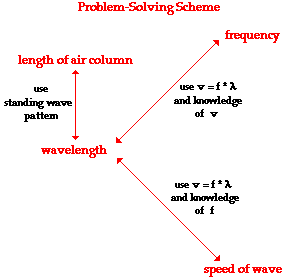
To demonstrate the use of the above problem-solving scheme, consider the following example problem and its detailed solution.
Example Problem #1
The speed of sound waves in air is 340 m/s. Determine the fundamental frequency (1st harmonic) of a closed-end air column that has a length of 67.5 cm.
The solution to the problem begins by first identifying known information, listing the desired quantity, and constructing a diagram of the situation.
| Given: v = 340 m/s L = 67.5 cm = 0.675 m | Find: f1 = ?? | Diagram: |
The problem statement asks us to determine the frequency (f) value. From the graphic above, the only means of finding the frequency is to use the wave equation (speed=frequency • wavelength) and knowledge of the speed and wavelength. The speed is given, but wavelength is not known. If the wavelength could be found then the frequency could be easily calculated. In this problem (and any problem), knowledge of the length and the harmonic number allows one to determine the wavelength of the wave. For the first harmonic, the wavelength is four times the length. This relationship is derived from the diagram of the standing wave pattern (see table above). The relationship, which works only for the first harmonic of a closed-end air column, is used to calculate the wavelength for this standing wave.
Wavelength = 4 • Length
Wavelength = 4 • 0.675 m
Wavelength = 2.7 m
Now that wavelength is known, it can be combined with the given value of the speed to calculate the frequency of the first harmonic for this closed-end air column. This calculation is shown below.
speed = frequency • wavelength
frequency = speed / wavelength
frequency = (340 m/s) / (2.7 m)
frequency = 126 Hz
Most problems can be solved in a similar manner. It is always wise to take the extra time needed to set the problem up; take the time to write down the given information and the requested information, and to draw a meaningful diagram.
Seldom in physics are two problems identical. The tendency to treat every problem the same way is perhaps one of the quickest paths to failure. It is much better to combine good problem-solving skills (part of which involves the discipline to set the problem up) with a solid grasp of the relationships among variables. Avoid the tendency to memorize approaches to different types of problems.
To further demonstrate the use of the above problem-solving scheme, consider the following example problem and its detailed solution.
Example Problem #2
Determine the length of an closed-end air column that produces a fundamental frequency (1st harmonic) of 480 Hz. The speed of waves in air is known to be 340 m/s.
The solution to the problem begins by first identifying known information, listing the desired quantity, and constructing a diagram of the situation.
| Given: v = 340 m/s f1 = 480 Hz | Find: L = ?? | Diagram: |
The problem statement asks us to determine the length of the air column. From the graphic above, the only means of finding the length of the air column is from knowledge of the wavelength. But the wavelength is not known. However, the frequency and speed are given, so one can use the wave equation (speed = frequency • wavelength) and knowledge of the speed and frequency to determine the wavelength. This calculation is shown below.
speed = frequency • wavelength
wavelength = speed / frequency
wavelength = (340 m/s) / (480 Hz)
wavelength = 0.708 m
Now that the wavelength is found, the length of the air column can be calculated. For the first harmonic, the length is one-fourth the wavelength. This relationship is derived from the diagram of the standing wave pattern (see table above); it may also be evident to you by looking at the standing wave diagram drawn above. This relationship between wavelength and length, which works only for the first harmonic of a closed-end air column, is used to calculate the wavelength for this standing wave.
Length = (1/4) • Wavelength
Length = (1/4) • Wavelength
Length = 0.177 m
If you have successfully followed the logic of the two solutions above, then take a try at the following practice problems. As you proceed, be sure to be mindful of the numerical relationships involved in such problems. And if necessary, refer to the problem solving scheme presented above.
We Would Like to Suggest …
Why just read about it and when you could be interacting with it? Interact – that’s exactly what you do when you use one of The Physics Classroom’s Interactives. We would like to suggest that you combine the reading of this page with the use of our Standing Wave Patterns Interactive. You can find it in the Physics Interactives section of our website. The Standing Wave Patterns Interactive provides the learner an environment for exploring the formation of standing waves, standing wave patterns, and mathematical relationships for standing wave patterns.
Visit: Standing Wave Patterns Interactive
Check Your Understanding
1. Titan Tommy and the Test Tubes at a night club this weekend. The lead instrumentalist uses a test tube (closed-end air column) with a 17.2 cm air column. The speed of sound in the test tube is 340 m/sec. find the frequency of the first harmonic played by this instrument.
Answer: 494 Hz
Given:
v = 340 m/s
L = 17.2 cm = 0.172 m (use meters for length since the speed is given in units of meters/s)
The strategy for solving for the frequency of the first harmonic involves using the wave equation: v = f • λ where λ is the wavelength of the first harmonic. Since the wavelength is not stated, it will have to be calculated from the knowledge of the length of the closed-end air column. For the first harmonic, the wavelength is four times the length of the air column (see Tutorial page).
λ = 4 • L = 4 • (0.172 m) = 0.688 m
Now rearrange the wave equation v = f • λ to solve for frequency.
f1 = v / λ = (340 m/s) / (0.688 m) = 494 Hz
2. A closed-end organ pipe is used to produce a mixture of sounds. The third and fifth harmonics in the mixture have frequencies of 1100 Hz and 1833 Hz respectively. What is the frequency of the first harmonic played by the organ pipe?
Answer: 367 Hz
Given:
f = 1100 Hz (3rd Harmonic)
f = 1833 Hz (5th Harmonic)
The frequencies of the various harmonics of a closed end air column are whole-number multiples of the frequency of the first harmonic. Each harmonic frequency (fn) is given by the equation fn = n • f1 where n is the harmonic number and f1 is the frequency of the first harmonic. Rearranging this equation leads to f1 = fn / n. So using the fifth harmonic frequency (f5) or the third harmonic frequency (f3), the first harmonic frequency can be calculated.
f1 = (1100 Hz) / 3 or (1833 Hz) / 5 = 367 Hz Se
3. Pipin’ Pete is playing at City Park next weekend. One of the closed-end pipes is capable of sounding out a first harmonic of 349.2 Hz. The speed of sound in the pipe is 350 m/sec. Find the length of the air column inside the pipe.
Answer: 0.250 m
Given: f = 349.2 Hz (1st H)
v = 350 m/s
The length of a closed-end air column is related mathematically to the wavelength of the wave which resonates within it. Thus the strategy for solving for length will be to first determine the wavelength of the wave using the wave equation and the knowledge of the frequency and the speed. The wave equation states that v = f •λ where λ is the wavelength of the wave. Rearranging this equation and substituting allows one to determine the wavelength.
λ = v / f = (350 m/s) / (349.2 Hz) = 1.00 m
For the first harmonic, the length of a closed-end air column is one-fourth the wavelength of the wave (see Tutorial page). Thus, the following calculation can be performed:
L = 0.25 • λ = 0.250 m